

Counting On Worksheet: Start Big and Count On

Students add by saying the bigger number and counting on, with think bubbles, checkbox items, a 1 to 20 number track and two story problems.

Format

Color, printable and fillable PDFs are ready. Google Classroom is on the way.

At a glance
Grades
K–1
Pages
3
Type
Worksheet
Includes
Answer key

Materials: none (counters and a cup for the warm-up game on the key, optional)

Answer key included

Last updated

Adding by counting on from the bigger number

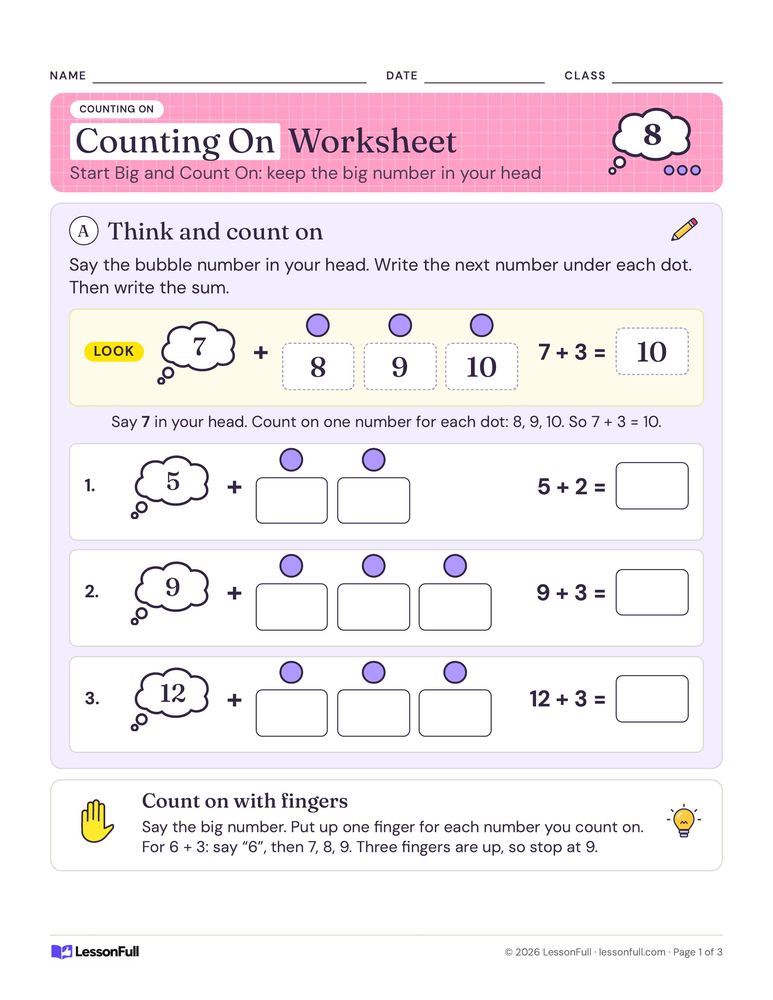
The first row is filled in: 7 sits in a think bubble, three dots follow, and 8, 9, 10 go under the dots to show 7 + 3 = 10. Students repeat this with 5 + 2, 9 + 3 and 12 + 3. In Start big the bigger number is not always first: for 2 + 9 they check 9 and count on two, but in 6 + 2 the first number is the one to check. Four items use a number track from 1 to 20, and stories about apples and ducks end the page.

Bring it into your classroom.

Students will

Learning objectives

  • Say the bigger addend and count on by the smaller one to find a sum within 20.
  • Write the counting words that follow a start number, one per dot.
  • Choose the bigger number in a sum where the smaller number comes first.
  • Use a number track to move one square for each number added.
  • Solve a short story problem by counting on.

From the creator

Teaching tips

1

Children who say the start number again, counting "7, 8, 9" for 7 + 3, land one short. Have them tap the bubble, say 7 quietly, then count only the dots out loud, as the key suggests.

2

Before Start big, ask which is faster: 2, then nine more counts, or 9, then two. Item 6 + 2 checks the first number, so children must look rather than always marking the second box.

3

Play the hidden-counters game from the key first: 7 counters under a cup, 3 beside it, count on 8, 9, 10, then lift the cup to confirm 10.

Differentiation

Meet every learner.

Ways to adjust the 13 counting-on items for different children.

Support

Dots and fingers only

  • Do only the three think-bubble items and the two stories, using fingers as the page 1 tip shows.
  • Give counters to set on the number track squares for 11 + 3 and 14 + 4.
  • Read the apple and duck stories aloud and act them out with counters.
On level

Teach as written

  • Both student pages after the filled-in 7 + 3 row.
  • Children say the start number quietly and the counting words out loud.
Extension

Bigger jumps and turn-arounds

  • Write 3 + 8 beside 8 + 3 and check that both land on 11.
  • Make new number-track items that start above 16, such as 17 + 3, and explain why the track would need to go past 20.
  • Pose stories where the smaller number comes first, such as 3 ducks and 12 more.

Standards alignment.

Each one is checked against the official documents. Where the resource covers only part of a standard, the note says so.

Common Core Math · Grade 1
1.OA.C.5Relate counting to addition by counting on

Children keep the first number in their head and count on one number for each dot or finger, writing 5 … 6, 7 for 5 + 2, and move along a 1-to-20 number track for 11 + 3 and 16 + 3. Counting on is the only strategy; counting back for subtraction is not covered.

1.OA.C.6Add within 20 using strategies such as counting on

Children add within 20 by counting on from the bigger number, choosing 9 for 2 + 9 and 11 for 2 + 11. Subtraction and the making-ten and doubles strategies in the standard are not covered.

1.OA.A.1Solve add-to word problems within 20

Children solve two add-to stories, 8 apples plus 3 more and 9 ducks plus 4 more, by counting on. Only this one story type appears, with no unknown at the start or in the middle and no equation with a symbol for the unknown.

TEKS Math · Grade 1
1.3(D)Count on from the bigger number

Students keep the first number in their head and count on one number for each dot (9, then 10, 11, 12 for 9 + 3), check the bigger number first for 2 + 9 and 3 + 8, and hop along a 1 to 20 number track for 16 + 3; making 10 and subtraction are not covered.

1.3(B)Count on in story problems

Students count on to solve two joining stories, 8 apples plus 3 more and 9 ducks plus 4 more, both within 20; separating and comparing stories and missing-part problems are not covered.

Good to know.

Does it use number lines?

No. Page 2 uses a number track of 20 numbered squares, so children move one square per count instead of hopping along a line.

No reviews yet.

Used it in class? Your notes help another teacher plan.

Counting On Worksheet: Start Big and Count On · 3 pages · Support 3 · Extension 3
Counting On Worksheet: Start Big and Count On — Counting On Worksheet, Think and count on (page 1 of 3)
Page 1 of 3 · Page 1
Counting On Worksheet: Start Big and Count On — Start big, Number track, Story problems (page 2 of 3)
Page 2 of 3 · Page 2
Counting On Worksheet: Start Big and Count On — answer key (page 3 of 3)
Page 3 of 3 · Page 3
Counting On Worksheet: Start Big and Count On, Support version, page 1
Support version Page 1 of 3
Counting On Worksheet: Start Big and Count On, Support version, page 2
Support version Page 2 of 3
Counting On Worksheet: Start Big and Count On, Support version, page 3
Support version Page 3 of 3
Counting On Worksheet: Start Big and Count On, Extension version, page 1
Extension version Page 1 of 3
Counting On Worksheet: Start Big and Count On, Extension version, page 2
Extension version Page 2 of 3
Counting On Worksheet: Start Big and Count On, Extension version, page 3
Extension version Page 3 of 3
ReviewingCounting On Worksheet: Start Big and Count On

How did it go in your classroom?

Your rating *
How did you use it?