Learning objectives
- Add two numbers within 20 by drawing one hop for each unit on a number line.
- Write a number sentence from hops drawn on a number line.
- Add a multiple of ten to a two-digit number with big hops on an open number line.

Students add by drawing hops on 0–20 number lines, write number sentences from drawn hops, then add tens with big hops on open lines.
Download the landscape PowerPoint file, open it in Google Slides and save it as Google Slides before assigning a copy to each student. Teacher material stays in the original PDF. Classroom setup instructions.
Last updated
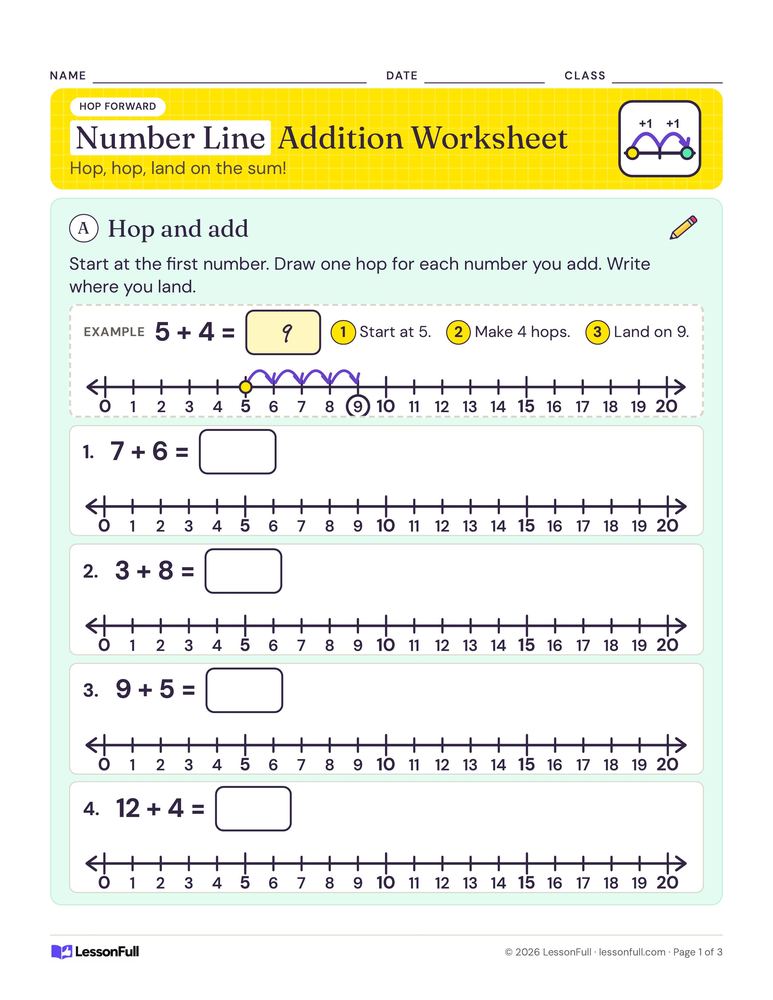
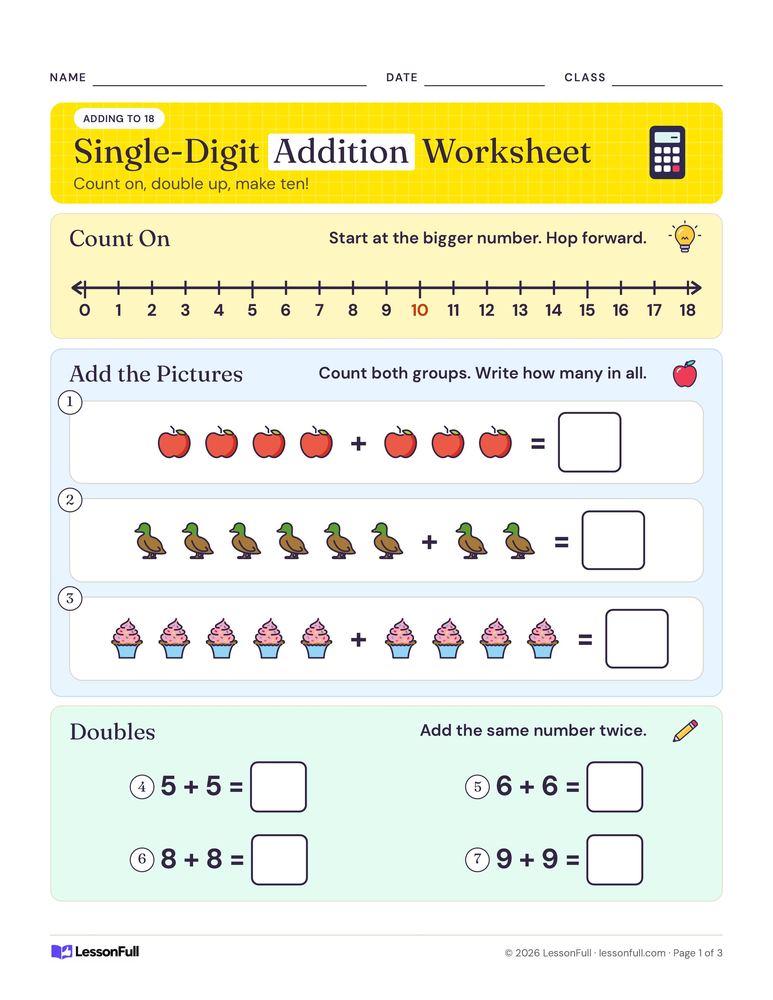
A dashed example works 5 + 4: start at 5, make 4 hops, land on 9. Items 1 to 4, with sums to 16, each get a full-width 0–20 line so hops stay large enough to count. In Part B the hops are already drawn from a start dot and students write start + hops = sum, which checks that they count arcs rather than tick marks. Part C moves to open number lines, where 23 + 30, 41 + 20 and 18 + 50 take one big hop per ten.
The most common error is counting the start number as the first hop, so 6 + 5 lands on 10. The key's floor game makes it visible: the child standing on 6 does not move until the class says one.
In Part B, children who count tick marks instead of arcs get 7 for 8 + 6. Have them touch each arc as they count.
On the open lines in Part C the hops need not be equal in size. The key says what matters is one hop per ten and the right landing number, so do not mark down uneven drawings.
Ways to adjust the hop problems and the open-line tens problems.
Topic 2Number line addingYou are here
Topic 3Doubles
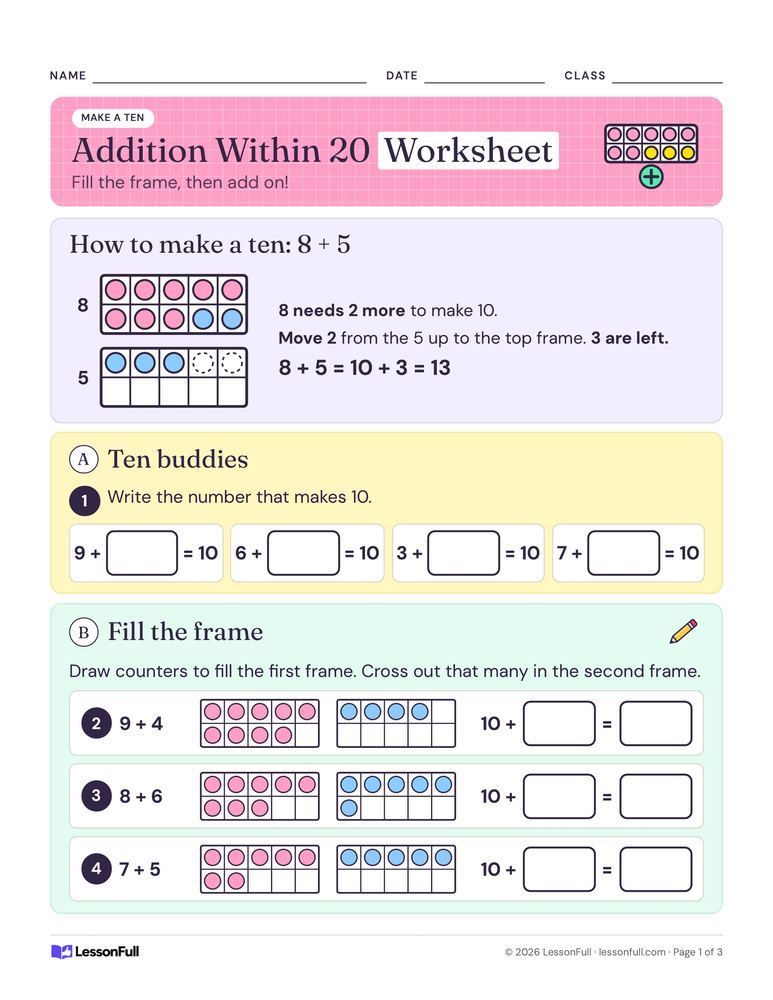
Topic 4Making 10
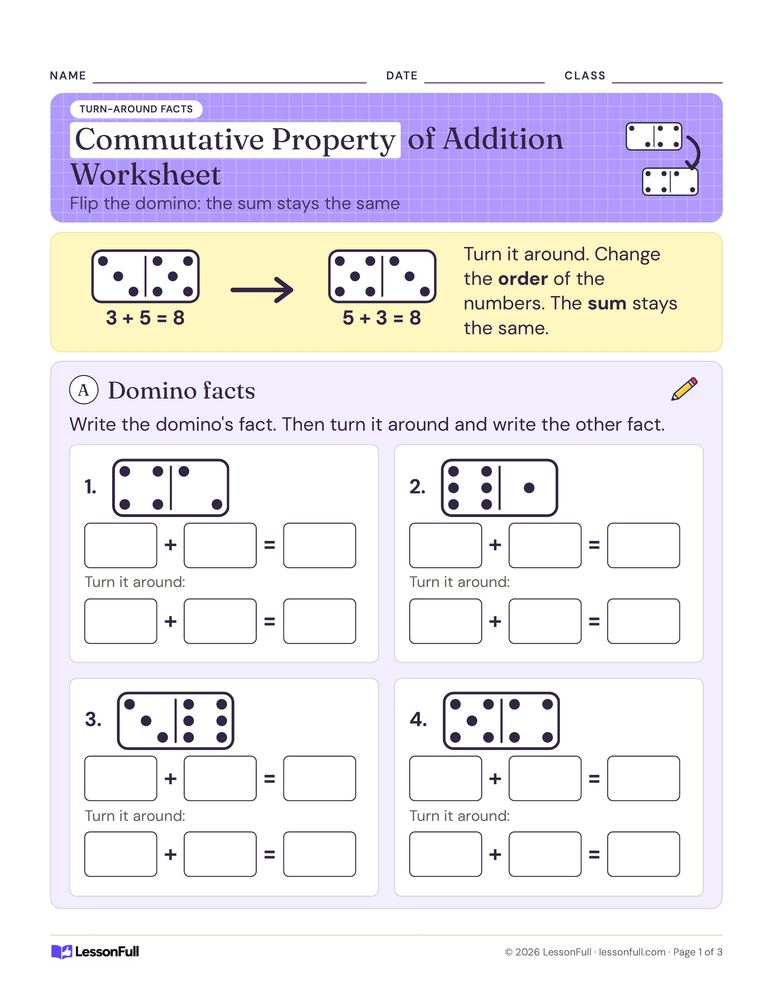
Topic 5Addition properties
Topic 6Adding three numbers
Topic 7Add within 20
Topic 8Word problems
Topic 9Facts within 10
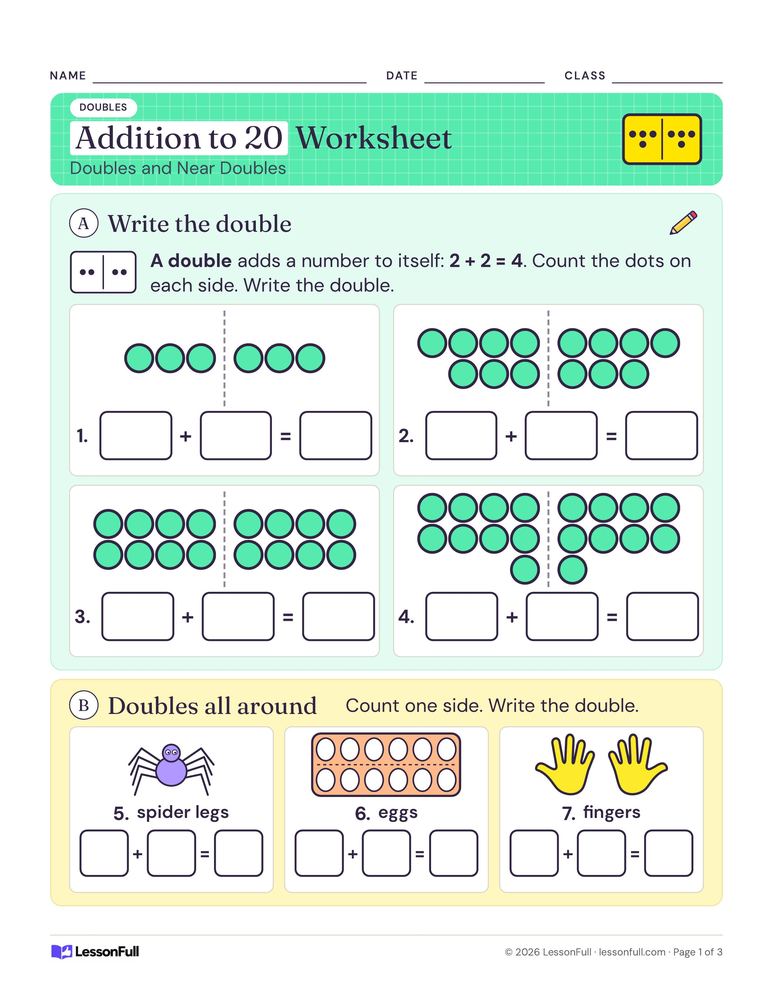
Next topic · 3 →Addition to 20 Worksheet: Doubles and Near DoublesDoubles and near doublesEach one is checked against the official documents. Where the resource covers only part of a standard, the note says so.
Students start at the first number and draw one hop for each number added on a 0 to 20 line for 7 + 6, 3 + 8, 9 + 5 and 12 + 4, then read drawn hops back as number sentences such as 8 + 6 = 14. Subtraction and the make-ten strategy are not on this page.
Every problem is shown as hops along a number line with equally spaced points from 0 to 20, and Part C uses an open number line for sums within 100 such as 23 + 30. Only sums are shown, not differences.
Part C adds tens to a two-digit number (23 + 30, 41 + 20, 18 + 50) with one big hop for each ten, then students make up their own. Adding a one-digit number to a two-digit number, and explaining the reasoning in writing, are not asked for.
Students draw hops on a 0-to-20 number line for 7 + 6, 3 + 8, 9 + 5 and 12 + 4, write the number sentence for two sets of drawn hops, and add tens on an open number line (23 + 30); explaining in spoken words and subtraction are not covered.
No. The 0–20 lines carry the counting; a child who can count on from a number can finish Part A. Part C expects counting by tens (23, 33, 43, 53).
Used it in class? Your notes help another teacher plan.