Single-Digit Subtraction Worksheet

Children cross out pictures to subtract, answer six facts within 10, hop back on number lines and write a number sentence for a balloon story.

Format

Download the landscape PowerPoint file, open it in Google Slides and save it as Google Slides before assigning a copy to each student. Teacher material stays in the original PDF. Classroom setup instructions.

At a glance
Grades
K–1
Pages
3
Type
Worksheet
Includes
Answer key
Answer key included

Last updated

Subtracting within 10 with pictures, number lines and addition facts

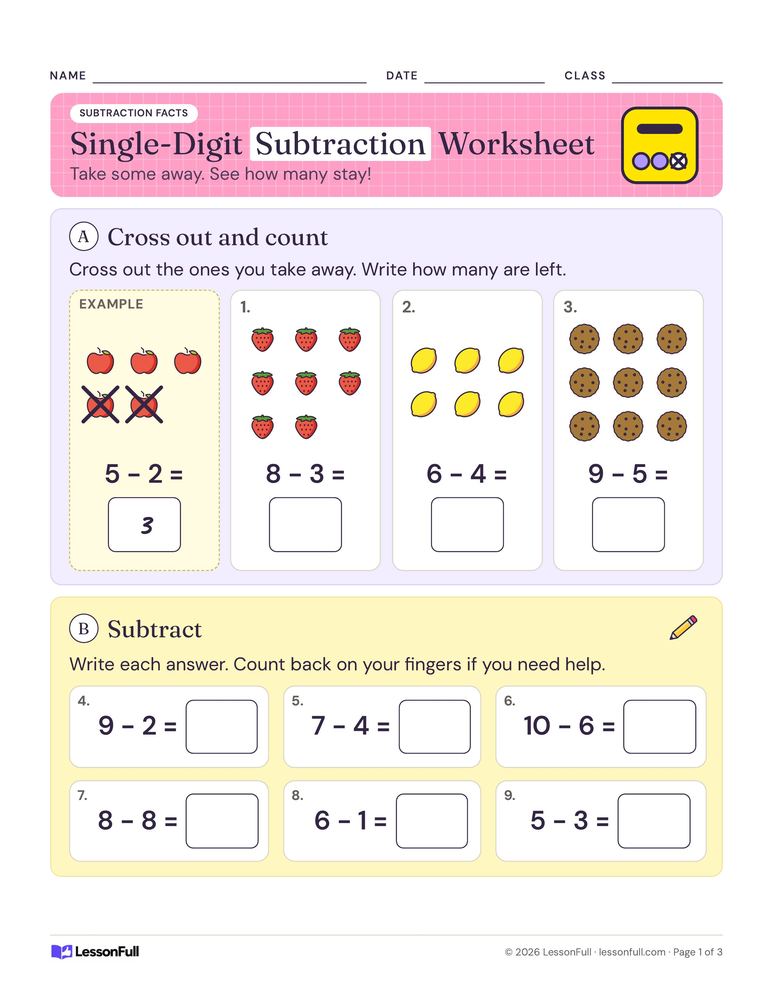
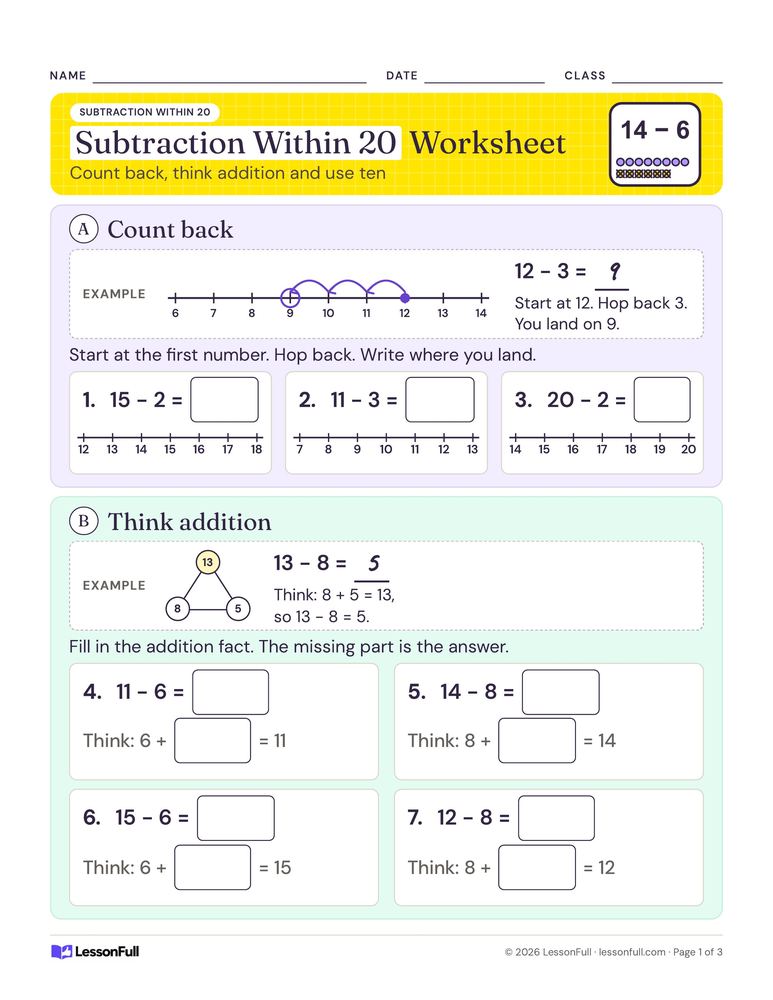
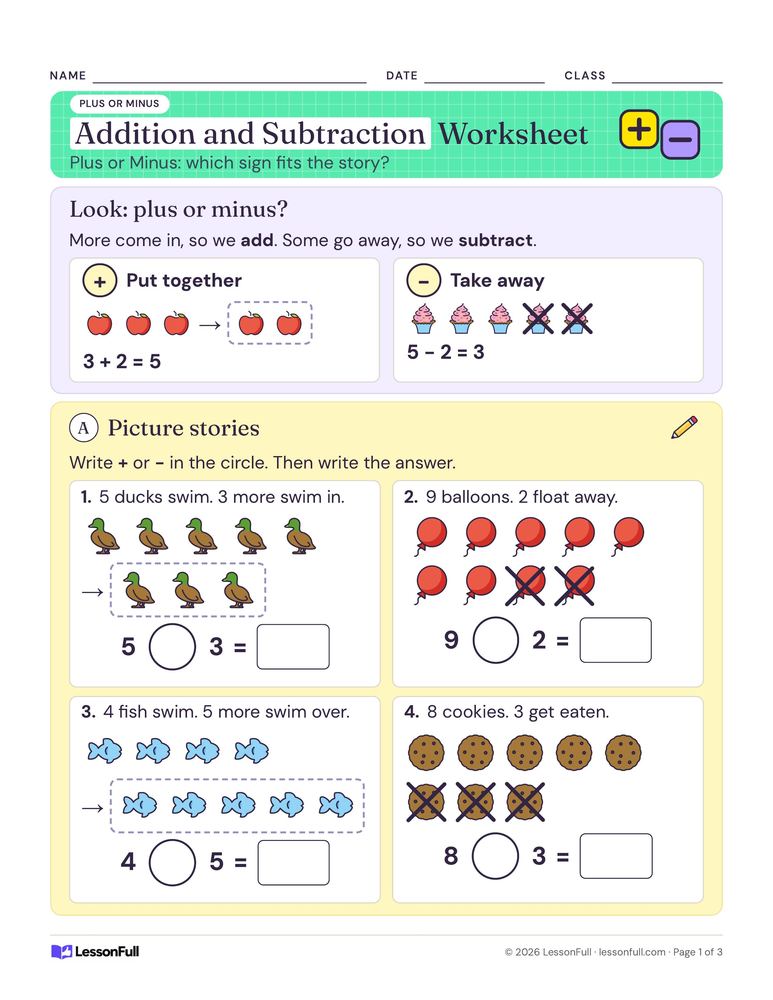
Every number is 10 or less, and each format gets a worked example before children try it. In Cross out and count, five apples with two crossed out show 5 − 2 = 3, then children cross out strawberries, lemons and cookies for 8 − 3, 6 − 4 and 9 − 5. Six facts in large type follow. Each number-line problem has its own 0 to 10 line. Two Think items turn 9 − 4 into 4 + ? = 9, and a story about Ava's seven balloons asks for the whole number sentence.

Bring it into your classroom.

Students will

Learning objectives

  • Subtract within 10 by crossing out pictures and counting what is left.
  • Count back on a number line to subtract 2 or 3.
  • Use a known addition fact to answer a related subtraction fact.
  • Write a subtraction number sentence for a take-away story.

From the creator

Teaching tips

1

The key names the number-line slip to watch for: children count the start number as the first hop, so 10 − 3 lands on 8. Have them put a finger on 10 and say zero before the first hop.

2

In Part A, some children write the number they crossed out instead of the number left. Ask them to point to the pictures that are still clear before writing.

3

Item 6, 10 − 6, is slow to count back. The key's tip is to think addition, 6 + 4 = 10. Part D on page 2 teaches that move, so some teachers do D before B.

Differentiation

Meet every learner.

Ways to adjust the picture, fact and number-line problems for different children.

Support

Real objects first

  • Act out 8 − 3 with eight counters before the strawberry picture, moving three away.
  • Do the picture and number-line items (1 to 3, 10 and 11) on paper; give the six facts in Part B with counters.
  • Read the balloon story aloud and draw the seven balloons on the board, crossing out two.
On level

Teach as written

  • All 14 items in order, with the directions read aloud.
  • Children say each hop aloud on the number lines before writing where they land.
Extension

Write the fact family

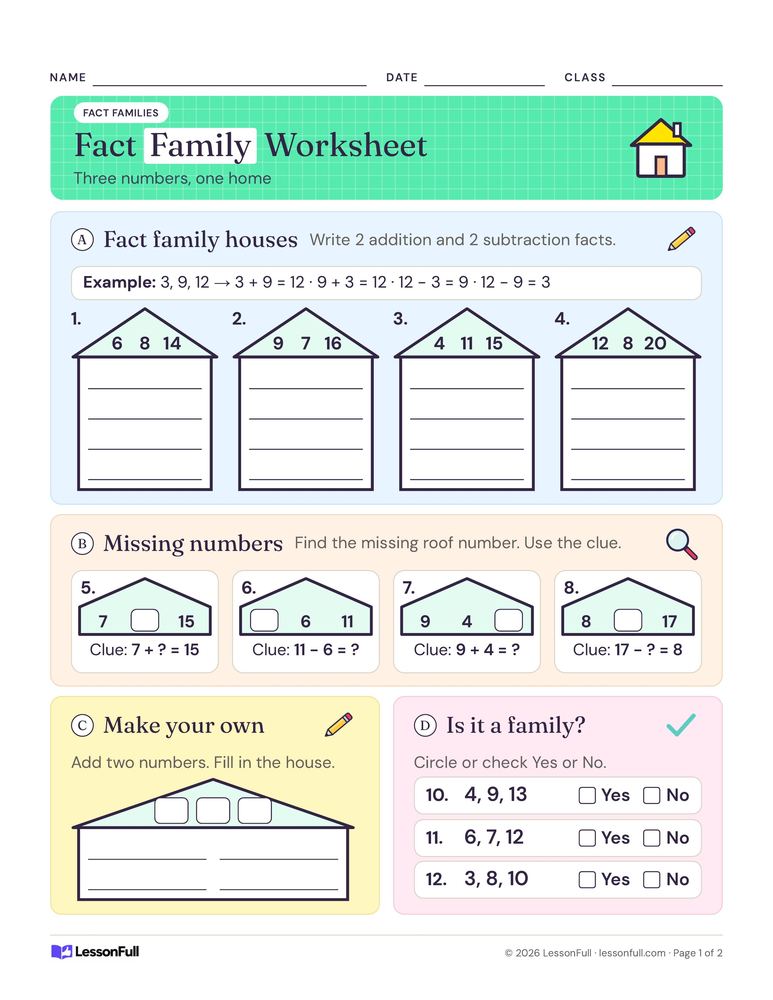
  • For items 12 and 13, write all four facts in the family (4 + 5, 5 + 4, 9 − 4, 9 − 5).
  • Write a balloon story for 9 − 5 and draw it.
  • Find every item on the two pages with the answer 5 (there are five) and explain why different starts give the same answer.

Standards alignment.

Each one is checked against the official documents. Where the resource covers only part of a standard, the note says so.

Common Core Math · Kindergarten–Grade 1
K.OA.A.2Solve subtraction word problems and subtract within 10 using objects or drawings

Students cross out pictures to subtract (8 − 3), subtract facts within 10, hop back on a number line, and write the number sentence for a balloon story (7 − 2). Addition problems are not on the page.

1.OA.C.6Add and subtract within 20, with fluency within 10, using strategies such as counting back

Students subtract within 10 by crossing out, counting back on fingers and hopping on a number line. Sums and differences within 20 are not covered.

1.OA.B.4Understand subtraction as an unknown-addend problem

In Part D students fill in 4 + ? = 9 and then use the same number for 9 − 4, which is this standard exactly, but on only two items.

TEKS Math · Kindergarten
K.3(B)Find differences within 10 with pictures

Students cross out pictures to subtract within 10, count back on a number line and solve one balloon story (7 − 2); there are no addition problems, and most items are bare number sentences rather than word problems.

K.3(C)Explain subtraction strategies

Students write number sentences, hop back on a number line and use an addition fact (4 + 5 = 9, so 9 − 4 = 5) to show how they subtract; explaining aloud is left to the teacher.

Good to know.

Does it go above 10?

No. Every start number is 10 or less; 10 − 6 and 10 − 3 are the largest. Teen numbers were left out so the page stays within single-digit subtraction.

No reviews yet.

Used it in class? Your notes help another teacher plan.

Single-Digit Subtraction Worksheet · 3 pages
Single-Digit Subtraction Worksheet — Single-Digit Subtraction Worksheet, Cross out and count, Subtract (page 1 of 3)
Page 1 of 3 · Page 1
Single-Digit Subtraction Worksheet — Number line hops, Use an addition fact, Balloon story (page 2 of 3)
Page 2 of 3 · Page 2
Single-Digit Subtraction Worksheet — answer key (page 3 of 3)
Page 3 of 3 · Page 3
ReviewingSingle-Digit Subtraction Worksheet

How did it go in your classroom?

Your rating *
How did you use it?