

Associative Property of Addition Worksheet

Students group two of three numbers first to add them, make a ten in six sums, solve three picture stories and judge true-or-false sentences.

Format

Color, printable and fillable PDFs are ready. Google Classroom is on the way.

At a glance
Grades
1
Pages
5
Type
Worksheet
Includes
Answer key

Materials: none (linking cubes optional)

Answer key included

Last updated

Choosing which two numbers to add first

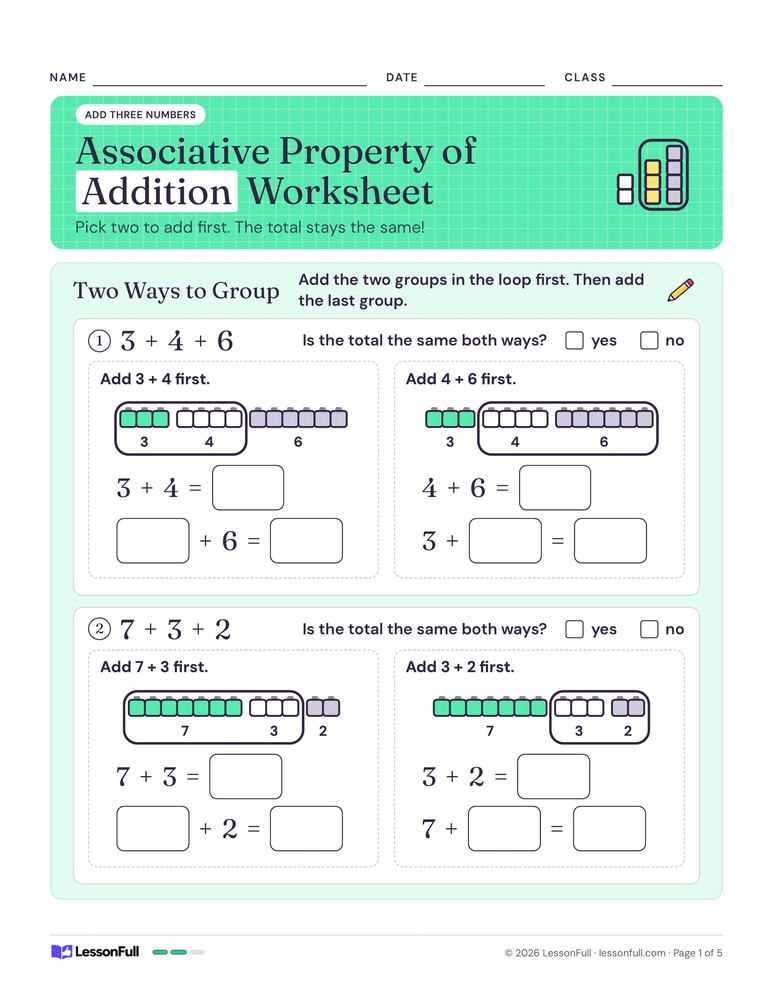
Grouping is shown as a loop around part of a three-color cube train, not with brackets: 3 + 4 + 6 is drawn twice, once with 3 + 4 looped and once with 4 + 6, and students check that both make 13. Six Make a Ten First sums put the pair that makes 10 first, last or split around the middle number. The stories show 7, 5 and 3 shells, 6, 8 and 4 stars and 5, 8 and 2 goals, each with a make-ten pair. Page 4 ends with four missing numbers and one written reason.

Bring it into your classroom.

Students will

Learning objectives

  • Add three one-digit numbers with totals to 20 by adding two of them first.
  • Show that adding a different pair first gives the same total.
  • Find the pair that makes 10 and add it first.
  • Decide whether a number sentence with three numbers on one side and two on the other is true.

From the creator

Teaching tips

1

Item 16, 6 + 4 + 2 = 10 + 4, is false: students spot the 10 and stop. Ask them to cover the pair that makes 10 and say what number is left on each side.

2

In item 18, 3 + 6 + 4 = 9 + 3, the 9 is 3 + 6, so the last number should be 4, not 3. Have students say which two numbers made the 9 before they mark it.

Differentiation

Meet every learner.

Three versions of the worksheet, each with its own answer key.

Support

Worked examples and marked pairs

  • Six pages with four Watch examples and the first answer traced in several items.
  • Student cube trains total 12 or less; Make a Ten First marks the pair, shows a ten frame and gives a word bank from 1 + 9 to 5 + 5.
  • Story counts are printed under the pictures, and Check the Match has students add both sides of three true sentences.
On level

Teach as written

  • Five pages: two cube trains grouped two ways, six make-ten sums, two Pick Your Pair items and three stories.
  • Six true-or-false items, four missing numbers and one written reason for Sam's choice.
Extension

Three ways and your own sum

  • Group 5 + 8 + 2 three ways and find the adding mistake in Ben's second way.
  • Totals up to 19, a story with the middle game's goals missing and missing numbers inside groupings, such as 4 + __ + 6 = 10 + 7.
  • Make your own sum of 15 with a pair that makes 10, then check off a three-line self-check.

Standards alignment.

Each one is checked against the official documents. Where the resource covers only part of a standard, the note says so.

Common Core Math · Grade 1
1.OA.B.3Group three addends in any order

Students add 3 + 4 + 6 two ways and see the total stays the same, find the two numbers that make 10 and add them first, pick their own pair, and explain which pair to add first in 6 + 7 + 4. Turn-around facts (commutative property) and subtraction strategies are not practised.

1.OA.A.2Word problems with three addends

Students count three groups of shells, stars and goals and write a three-addend number sentence with a total up to 18. The numbers come from pictures, and no equation has a symbol for an unknown number.

1.OA.D.7Meaning of the equal sign, true or false

Students check true or false for equations such as 7 + 3 + 6 = 10 + 6 and write the number that makes both sides the same. All equations are addition, so subtraction equations are not judged.

TEKS Math · Grade 1
1.5(G)Use properties of addition to add three numbers

Students add three numbers by grouping two first in different ways, check the total is the same both ways, and pick their own pair to add first. Subtraction is not included.

1.3(D)Use the make-a-ten fact strategy within 20

Students find the two numbers that make 10 in six sums such as 4 + 9 + 6, add them first, then add the last number, with all totals within 20. Subtraction strategies and breaking a number apart to reach 10 are not practiced.

1.5(E)The equal sign means both sides are the same

Students check true or false for six equations such as 7 + 3 + 6 = 10 + 6 and write the missing number that keeps both sides the same. Only addition expressions appear on each side.

Good to know.

Do students need the word associative or brackets?

No. The word appears only in the title. Students see grouping as a loop around cubes and follow prompts like add 3 + 4 first.

No reviews yet.

Used it in class? Your notes help another teacher plan.

Associative Property of Addition Worksheet · 5 pages · Support 6 · Extension 5
Associative Property of Addition Worksheet — Two Ways to Group (page 1 of 5)
Page 1 of 5 · Page 1
Associative Property of Addition Worksheet — Make a Ten First, Pick Your Pair (page 2 of 5)
Page 2 of 5 · Page 2
Associative Property of Addition Worksheet — Story Problems (page 3 of 5)
Page 3 of 5 · Page 3
Associative Property of Addition Worksheet — True or False?, Same on Both Sides, Your Choice (page 4 of 5)
Page 4 of 5 · Page 4
Associative Property of Addition Worksheet — answer key (page 5 of 5)
Page 5 of 5 · Page 5
Associative Property of Addition Worksheet, Support version, page 1
Support version Page 1 of 6
Associative Property of Addition Worksheet, Support version, page 2
Support version Page 2 of 6
Associative Property of Addition Worksheet, Support version, page 3
Support version Page 3 of 6
Associative Property of Addition Worksheet, Support version, page 4
Support version Page 4 of 6
Associative Property of Addition Worksheet, Support version, page 5
Support version Page 5 of 6
Associative Property of Addition Worksheet, Support version, page 6
Support version Page 6 of 6
Associative Property of Addition Worksheet, Extension version, page 1
Extension version Page 1 of 5
Associative Property of Addition Worksheet, Extension version, page 2
Extension version Page 2 of 5
Associative Property of Addition Worksheet, Extension version, page 3
Extension version Page 3 of 5
Associative Property of Addition Worksheet, Extension version, page 4
Extension version Page 4 of 5
Associative Property of Addition Worksheet, Extension version, page 5
Extension version Page 5 of 5
ReviewingAssociative Property of Addition Worksheet

How did it go in your classroom?

Your rating *
How did you use it?