
Students will
Learning objectives
- Say a three-sound word slowly and hear its first, middle and last sound in order.
- Write one letter for each sound to spell the whole word.
- Spell words from a picture, from a spoken word, and as labels on a picture.

Children say each picture name slowly and write one letter for each sound to spell 26 short words such as mop, tub and web.
Color, printable and fillable PDFs are ready. Google Classroom is on the way.
Last updated
Every word on the main pages has three sounds and one letter for each, so spelling by sound gives the right spelling. A model strip stretches van into three boxes: vvvaaannn. Children write eight picture words in sound boxes, then finish four words with one sound left out, such as b and t beside a bat, and write four more on a plain handwriting line. The teacher reads four words with a sentence each, and children label six things in an outdoor picture: sun, web, cat, bug, pig and log.

Name every picture together first, using the key's words. Some could be called something else: item 3 is a 10 card for ten, item 5 is a pushpin for pin, item 24 is a ladybug for bug and item 26 is a tree stump for log.
Item 12 shows j and m beside a jar of jam. A child who copies jm into the boxes has dropped the middle sound. Stretch jaaam and ask what sound is in the middle.
For items 17 to 20, say the word, the key's sentence, then the word again. Win starts with the w sound; a child who writes y has used the letter's name, so ask for the sound, not the letter.

Three versions of the CVC Spelling Worksheet, each four pages with its own answer key.
 Punctuation & Capitalization · Topic 2End marks
 Topic 1Letters for sounds
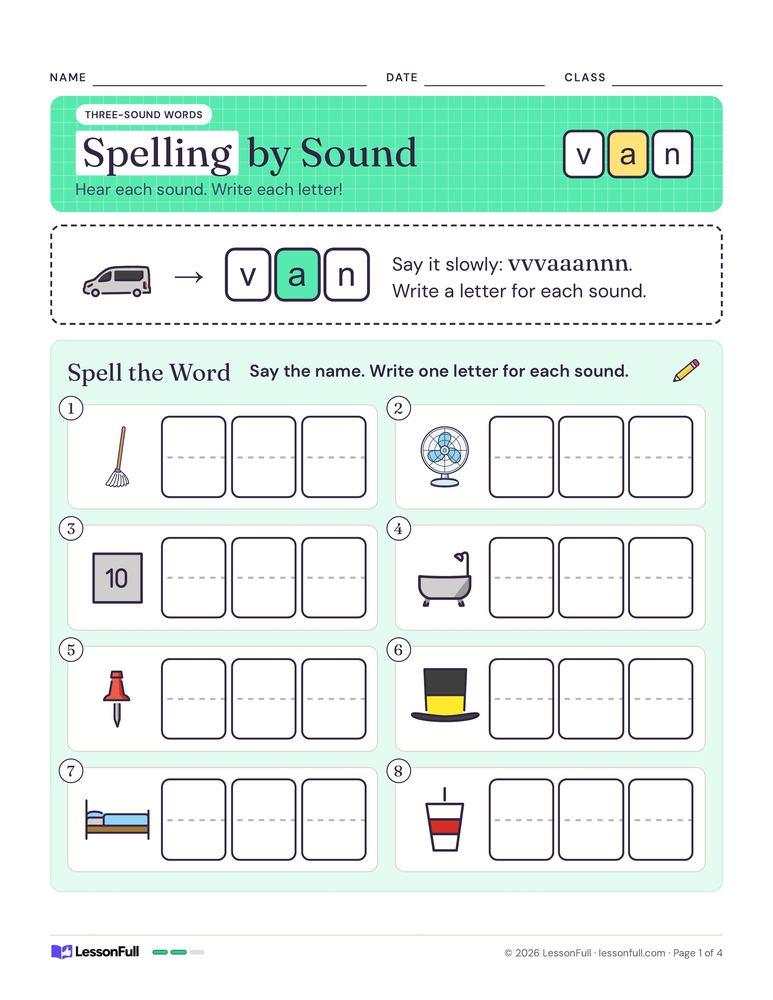 Topic 2Spelling by soundYou are here
 Grade 1 · Topic 1CVC review
Each one is checked against the official documents. Where the resource covers only part of a standard, the note says so.
Students say three-sound picture names such as mop, tub and bed and write a letter for each sound, fill in a missing letter and write the whole word, spell four words the teacher says, and label pictures in a scene. Every word has three sounds and a short vowel, so longer words are not spelled.
Each word asks for a consonant, a short vowel and a consonant, so students write the letter for all five short vowel sounds and many consonants. Sounds spelled with two letters, such as sh, are not used.
Students spell 26 three-sound words such as mop, tub and web in sound boxes, from half-written words, on a line, from dictation and as labels. Two-sound and four-sound words with a blend are not included.
Students say each picture word slowly and put one letter for each sound in a row of three sound boxes. Only three-sound words are broken apart.
The key says to praise it first: it shows the child heard every sound. Then show that these words are written with c.
Every picture word and every spelling word, in all three versions, is consonant, short vowel, consonant with one letter for each sound (the Extension phrases add only the little word a), so writing what you hear gives the right spelling. Two sounds side by side, as in frog, are Grade 1 spelling. The Extension version stays with three-sound words and stretches children with word pairs, sound changes, fixing mistakes and writing short phrases.
Used it in class? Your notes help another teacher plan.