

Ending Punctuation Worksheet

Children trace and name the three end marks, find the mark that ends each sentence, count marks in a story and choose marks by ear.

Format

Color, printable and fillable PDFs are ready. Google Classroom is on the way.

At a glance
Grades
K
Pages
4
Type
Worksheet
Includes
Answer key

Materials: pencil

Answer key included

Last updated

Recognizing and naming the three end marks

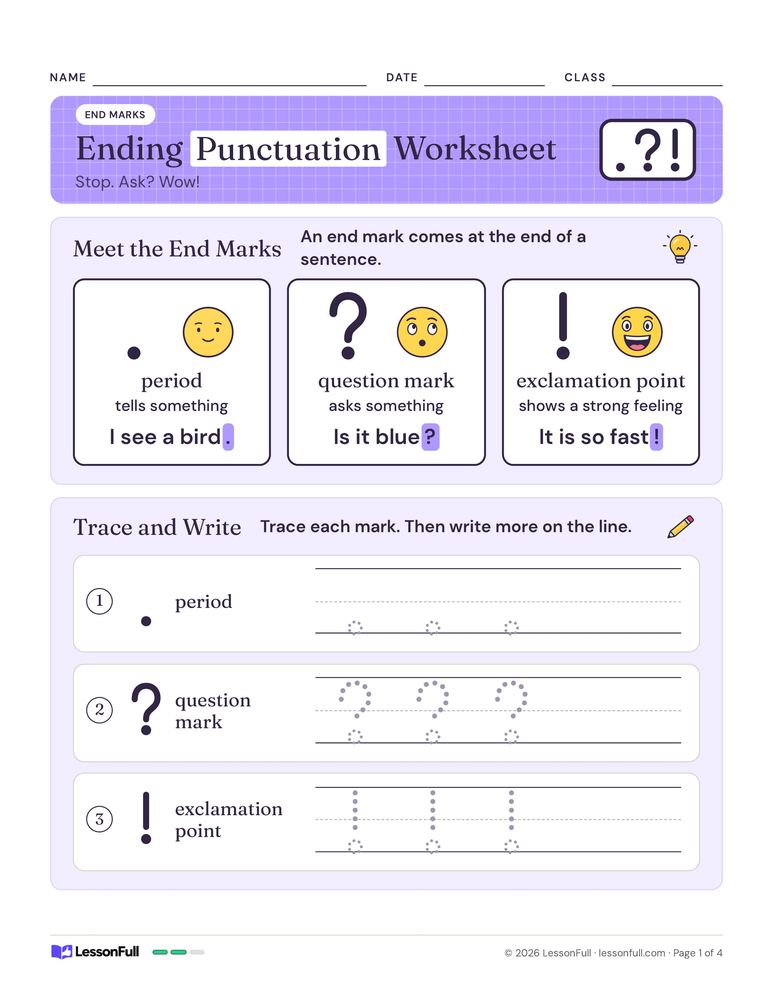
A three-card chart pairs each mark with its name, what it does and a face for the voice: calm for "I see a bird.", wondering for "Is it blue?" and excited for "It is so fast", which ends in an exclamation point. Children trace each mark, check the name of a mark shown alone, and check the mark at the end of four sentences. In "My Kite", two lines hold two sentences each, so children circle six marks, not four. Six sentences read aloud, two of each kind, end the set.

Bring it into your classroom.

Students will

Learning objectives

  • Name the period, question mark and exclamation point.
  • Find the end mark at the end of a sentence, including one that runs over two lines.
  • Trace and write each end mark with its dot on the bottom line.
  • Listen to a sentence read aloud and write the end mark that fits.

From the creator

Teaching tips

1

Many children put a period at the end of every line. Before Mark Hunt, run a finger along "Is it windy? I run fast." and stop at each mark, not at the line end.

2

Which Mark? only works read aloud. Read item 16, "Look out", loud and sharp and item 14, "Where is my hat", rising at the end, as the key's voice note describes.

Differentiation

Meet every learner.

Three versions of the Ending Punctuation Worksheet, each with its own answer key.

Support

Two marks first, with clues

  • Page 1 teaches only the period and question mark; the exclamation point comes on page 2 with its own card and trace row.
  • A worked example shows the check for "Can we go?", and every asking sentence starts with a bold, underlined question word such as Can or Where.
  • More dotted marks to trace, and children circle the mark that fits instead of writing it. Four pages.
On level

Teach as written

  • Trace the three marks, check the name of each, and check the end mark in four sentences (items 1–10).
  • Count the marks in the kite story and write the missing mark in six sentences read aloud, two of each kind (items 11–19). Four pages.
Extension

Same words, different mark

  • "It is here" and "The bus is late" are each written with all three marks and matched to a calm, wondering or excited face.
  • Eight sentences with no clues to finish, then children tell a partner why they chose two of the marks.
  • Cross out two wrong marks, fix "we go to the park" (capital letter and period), and write one sentence three ways. Four pages.

Standards alignment.

Each one is checked against the official documents. Where the resource covers only part of a standard, the note says so.

Common Core ELA · Kindergarten
L.K.2.bRecognize and name end marks

Students trace a period, question mark and exclamation point, check each mark's name, find the end mark of a sentence, count each kind in a short story, and write the right mark at the end of six sentences read aloud. Other punctuation is not covered.

TEKS English · Kindergarten
K.10(D)(viii)Put a mark at the end of a telling sentence

Students write the missing end mark for six spoken sentences, including periods for telling sentences, and circle and count periods in a short story. Students mark printed sentences, not their own drafts; question marks and exclamation points go beyond this standard.

Good to know.

Does it teach sentence types such as statement and command?

No. Children learn the name of each mark and what it does: tells something, asks something or shows a strong feeling. Sentence-type names are left out.

Do children have to read the sentences on their own?

No. In Which Mark? an adult reads each sentence aloud, and the key says how to let your voice show the mark.

No reviews yet.

Used it in class? Your notes help another teacher plan.

Ending Punctuation Worksheet · 4 pages · Support 4 · Extension 4
Ending Punctuation Worksheet — Meet the End Marks, Trace and Write (page 1 of 4)
Page 1 of 4 · Page 1
Ending Punctuation Worksheet — Name the Mark, Find the End Mark (page 2 of 4)
Page 2 of 4 · Page 2
Ending Punctuation Worksheet — Mark Hunt, My Kite, Which Mark? (page 3 of 4)
Page 3 of 4 · Page 3
Ending Punctuation Worksheet — answer key (page 4 of 4)
Page 4 of 4 · Page 4
Ending Punctuation Worksheet, Support version, page 1
Support version Page 1 of 4
Ending Punctuation Worksheet, Support version, page 2
Support version Page 2 of 4
Ending Punctuation Worksheet, Support version, page 3
Support version Page 3 of 4
Ending Punctuation Worksheet, Support version, page 4
Support version Page 4 of 4
Ending Punctuation Worksheet, Extension version, page 1
Extension version Page 1 of 4
Ending Punctuation Worksheet, Extension version, page 2
Extension version Page 2 of 4
Ending Punctuation Worksheet, Extension version, page 3
Extension version Page 3 of 4
Ending Punctuation Worksheet, Extension version, page 4
Extension version Page 4 of 4
ReviewingEnding Punctuation Worksheet

How did it go in your classroom?

Your rating *
How did you use it?