

Letter D Worksheet

Children trace big D and little d, color pictures that start with the d sound, and dot every d among look-alike letters.

Format

Only the color PDF is ready for this resource so far. The other formats are on the way.

At a glance
Grades
Pre-K–K
Pages
2
Type
Worksheet
Includes
Answer key
Answer key included

Last updated

Tracing, hearing and dotting the letter d

Children trace dotted D's and d's, listen for the d sound, then find the letter among look-alikes. An arrow beside each model shows the first stroke: straight down for big D, round first for little d. Six unlabeled drawings follow, and students color or check the four that start with d. Bell is the one to watch, since b and d sound alike at the start. In Dot the d, children dab each d hiding among b, p, q, a and o with a dot marker or a check.

Bring it into your classroom.

Students will

Learning objectives

  • Write uppercase D and lowercase d, making the round part of little d first.
  • Pick out the pictures whose names start with the d sound, leaving out bell and sun.
  • Find lowercase d among b, p and q by the side its stick is on.

From the creator

Teaching tips

1

Before the picture section, say "bell" and "duck" and have children feel the difference, as the key suggests: for b the lips pop open; for d the tongue taps just behind the top teeth.

2

In Dot the d, a child who marks letter 2 or letter 8 is reading b as d. Ask which side the tall stick is on: little d makes the round part first, then the stick on the right.

Differentiation

Meet every learner.

Ways to adjust the Letter D page for different learners.

Support

Fewer letters at a time

  • Trace two dotted letters in each row, then write one of their own.
  • Name the six pictures together and color the d pictures one row at a time.
  • Cover the bottom row of the cloud and find the d's in the top seven letters first.
On level

Teach as written

  • All three sections, with you naming each picture first.
  • Students count the d's they dotted and check that they found four.
Extension

More d words

  • Say a different d word for each d they dotted in the cloud.
  • Circle the b's in the cloud in a second color and explain how they differ from d.

Standards alignment.

Each one is checked against the official documents. Where the resource covers only part of a standard, the note says so.

Common Core ELA · Kindergarten
RF.K.3.aKnow the most common sound for each consonant

Students say each picture name and color the ones that start with the d sound (duck, drum, door, doughnut), linking the letter d to its sound. Other consonants are not practiced.

L.K.1.aPrint many upper- and lowercase letters

Students trace big D and little d and then write their own. Only this one letter is covered.

RF.K.1.dRecognize and name all upper- and lowercase letters

Students find every little d among look-alike letters such as b, p and q. Only lowercase d is picked out, and students do not name the other letters.

TEKS English · Kindergarten
K.2(B)Match letters to their sounds

Children say each picture name and color the ones that start with the d sound (duck, drum, door, doughnut), matching the letter d to its sound; only one letter sound is practiced.

K.2(E)Form uppercase and lowercase letters

Children trace and then write big D and little d, following start-point directions; only these two letters are practiced, not the full alphabet.

K.2(D)Identify uppercase and lowercase letters

Children find every little d in a cloud of look-alike letters (b, p, q); only the letter d is practiced, not all letters.

No reviews yet.

Used it in class? Your notes help another teacher plan.

Letter D Worksheet · 2 pages
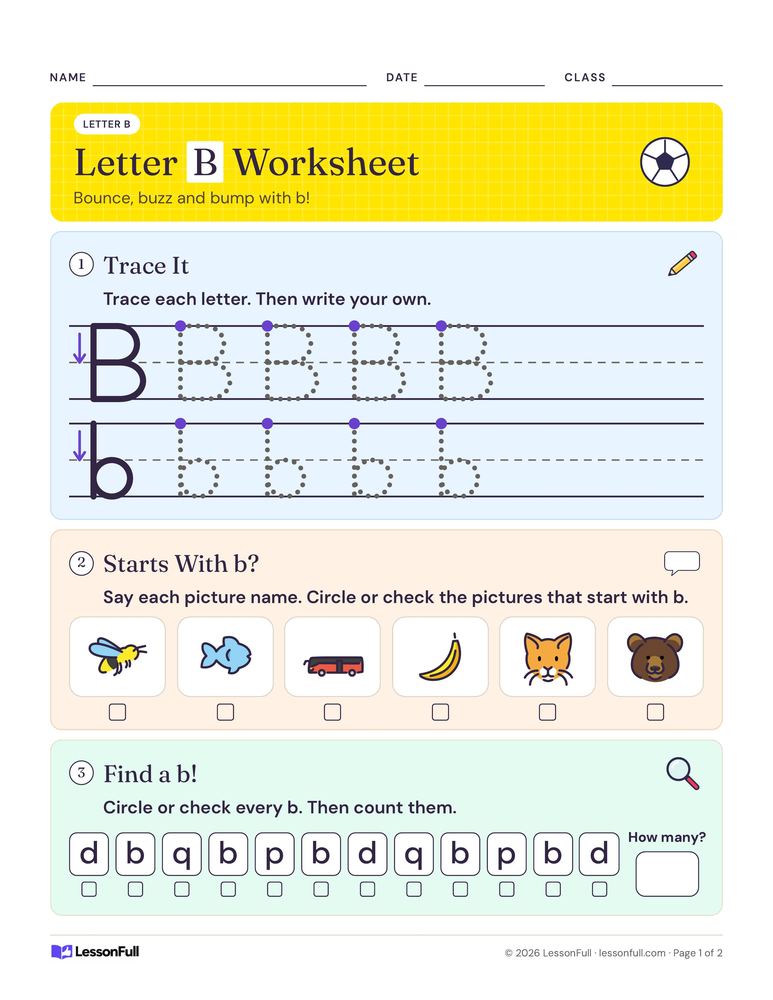
Letter D Worksheet: tracing rows for big D and little d, six pictures to color if they start with d, and a letter cloud to dot each d
Page 1 of 2 · Page 1
Letter D Worksheet: answer key with the duck, drum, door and doughnut highlighted, the four d letters circled and a teacher tip on b and d
Page 2 of 2 · Page 2
ReviewingLetter D Worksheet

How did it go in your classroom?

Your rating *
How did you use it?