

Kindergarten Informational Writing Worksheet

Children study an "All about a bike" model, check facts, label a backpack, finish has, can and is facts, then make their own all-about page.

Format

Color, printable and fillable PDFs are ready. Google Classroom is on the way.

At a glance
Grades
K
Pages
4
Type
Worksheet
Includes
Answer key

Materials: pencil and crayons

Answer key included

Last updated

Writing an all-about page with a topic, labels and facts

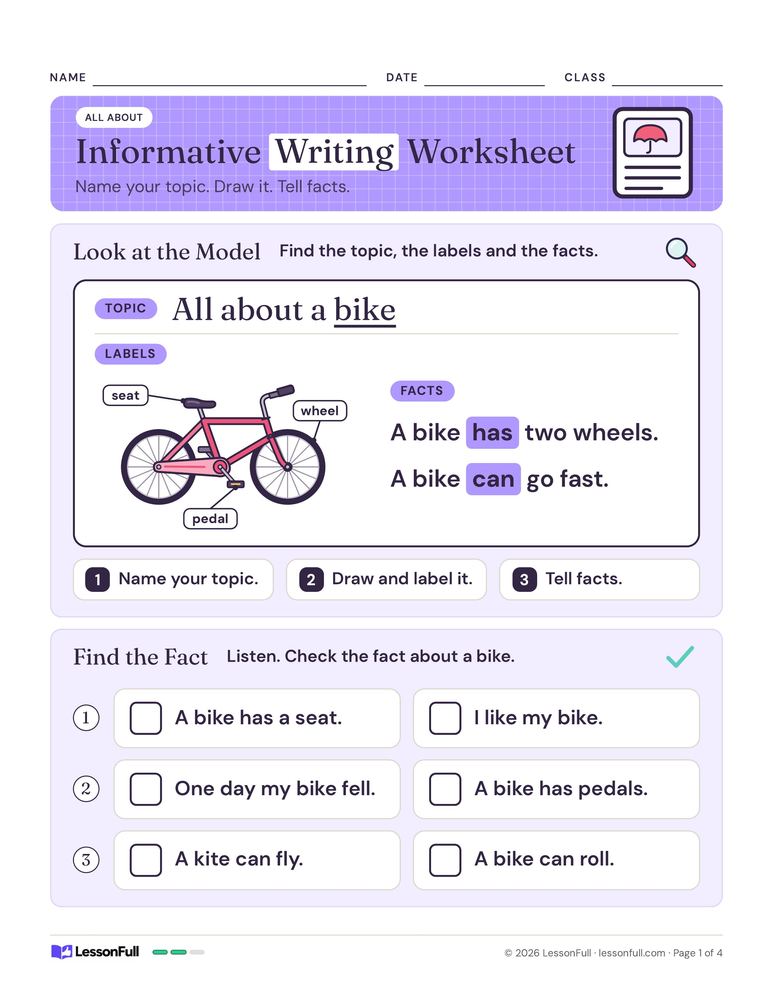
The model page shows the three parts children copy later: the topic line "All about a bike", a drawing labeled seat, wheel and pedal, and two facts starting with has and can. In Find the Fact, each true bike fact sits beside one of three usual slips: "I like my bike", a "One day" story, or a true sentence about a kite. On their own page, children pick a shoe, cup, chair, umbrella or their own idea, draw and label it, and write or tell a grown-up two facts.

Bring it into your classroom.

Students will

Learning objectives

  • Write or say the topic of an all-about page.
  • Draw the topic and label its parts.
  • Tell or write two facts about the topic using has, can or is.
  • Choose the sentence that tells a fact over one that tells what the writer likes or a story.

From the creator

Teaching tips

1

Children who have just done opinion writing often write "I like my shoe." Ask the key's questions: "What does it have? What can it do?"

2

Item 3 is the hardest Find the Fact item because "A kite can fly" is true. Ask "Is that about a bike?" before children check.

3

Before page 3, hold up a pencil and have the class tell one has, one can and one is fact on their fingers, as in the key's 10-minute class routine.

Differentiation

Meet every learner.

Three versions of the Informative Writing Worksheet, each with its own answer key.

Support

Picture choices and one fact

  • Find the Fact becomes a worked example and four pictures to check for a bike: seat, pedal, cup and handlebars.
  • Picture cues sit beside the word bank, the topic and first label are traced, and children finish one fact with has after a worked bike example.
  • On their own page, children label one part and tell one has fact for a grown-up to write. Four pages.
On level

Teach as written

  • Study the bike model, check three facts, name and label the backpack and finish the has, can and is facts.
  • Pick a topic, draw and label it, write or dictate two facts, and check the three boxes. Four pages.
Extension

Fact or likes, three facts

  • Mark four bike sentences as a fact or what the writer likes, and find the word in the bank that does not fit a backpack (wheel).
  • Turn three non-facts, such as "My backpack is the best", into backpack facts with has, can and is.
  • Choose any topic, label three parts, write a has, a can and an is fact, then add a Did you know fact. Four pages.

Standards alignment.

Each one is checked against the official documents. Where the resource covers only part of a standard, the note says so.

Common Core ELA · Kindergarten
W.K.2Informative writing: name the topic and tell facts

Students find the fact in pairs of sentences, label a backpack and finish facts with has, can and is, then pick their own topic, draw and label it, and tell two facts by writing or by telling an adult. Explaining how to do something is not asked.

TEKS English · Kindergarten
K.11(B)Dictate or write an informational text

Students make their own all-about page: they name a topic, draw and label it, and write or tell a grown-up two facts using has, can or is. The page is short, two facts with labels.

K.10(A)Plan writing by drawing

Before writing facts, students pick a thing they know well and draw and label it. Planning through class discussion is not part of the sheet.

Good to know.

Do children have to write the facts themselves?

No. The own page says "Write, or tell a grown-up to write", and the key counts a fact the child tells and an adult writes the same as one the child writes.

Does it teach an opening or closing sentence?

No. Children name the topic, draw and label it, and tell facts. There is no closing sentence or paragraph.

No reviews yet.

Used it in class? Your notes help another teacher plan.

Kindergarten Informational Writing Worksheet · 4 pages · Support 4 · Extension 4
Kindergarten Informational Writing Worksheet — Informative Writing Worksheet, Look at the Model, Find the Fact (page 1 of 4)
Page 1 of 4 · Page 1
Kindergarten Informational Writing Worksheet — Name It and Label It, Finish the Facts (page 2 of 4)
Page 2 of 4 · Page 2
Kindergarten Informational Writing Worksheet — Pick Your Topic, Draw and Tell (page 3 of 4)
Page 3 of 4 · Page 3
Kindergarten Informational Writing Worksheet — answer key (page 4 of 4)
Page 4 of 4 · Page 4
Kindergarten Informational Writing Worksheet, Support version, page 1
Support version Page 1 of 4
Kindergarten Informational Writing Worksheet, Support version, page 2
Support version Page 2 of 4
Kindergarten Informational Writing Worksheet, Support version, page 3
Support version Page 3 of 4
Kindergarten Informational Writing Worksheet, Support version, page 4
Support version Page 4 of 4
Kindergarten Informational Writing Worksheet, Extension version, page 1
Extension version Page 1 of 4
Kindergarten Informational Writing Worksheet, Extension version, page 2
Extension version Page 2 of 4
Kindergarten Informational Writing Worksheet, Extension version, page 3
Extension version Page 3 of 4
Kindergarten Informational Writing Worksheet, Extension version, page 4
Extension version Page 4 of 4
ReviewingKindergarten Informational Writing Worksheet

How did it go in your classroom?

Your rating *
How did you use it?