

CVC Sentences Worksheet

Children read sentences and two three-sentence stories on their own, then check the matching picture, answer yes or no, and draw what a sentence says.

Format

Color, printable and fillable PDFs are ready. Google Classroom is on the way.

At a glance
Grades
K
Pages
4
Type
Worksheet
Includes
Answer key

Materials: crayons or colored pencils

Answer key included

Last updated

Reading sentences and short stories on their own

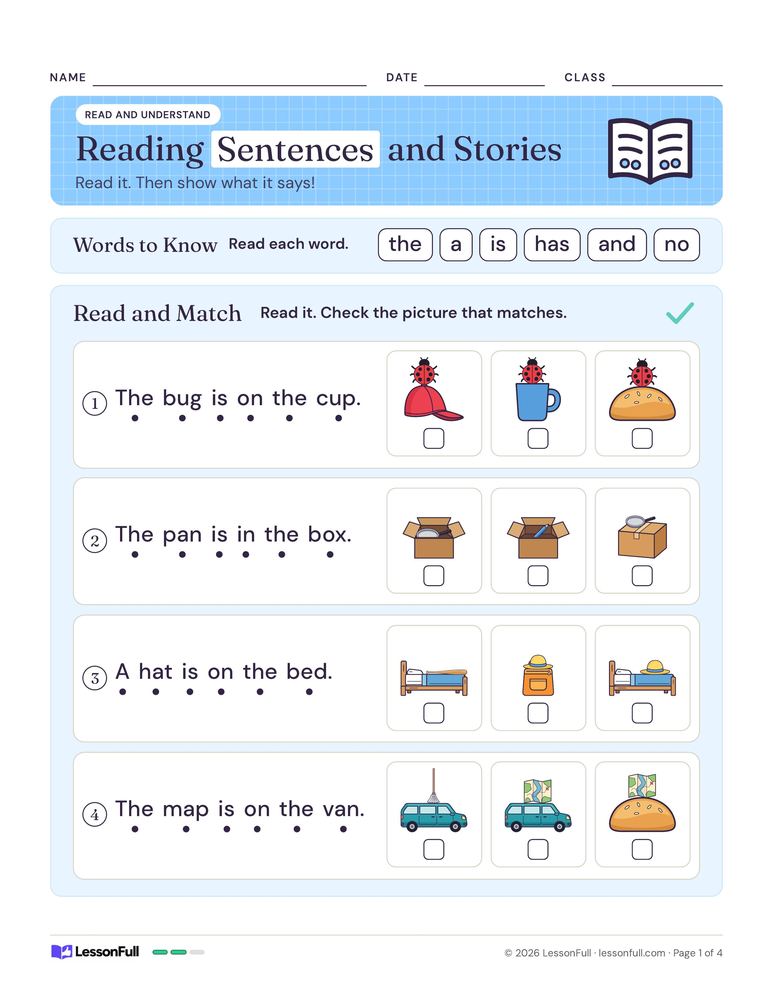
Every word is a short-vowel word of three sounds or fewer, a name (Kim or Ben), or one of six sight words: the, a, is, has, and, no. Children match four sentences like "The bug is on the cup" to one of three pictures, read two stories with no pictures and answer from the words, check yes or no for four picture questions, and draw two sentences. The wrong pictures change one thing, a cap or a bun in place of the cup, so a first-letter guess does not work.

Bring it into your classroom.

Students will

Learning objectives

  • Read short sentences made of sound-it-out words and six sight words without help.
  • Check the picture that matches a sentence.
  • Answer picture and yes-or-no questions about a three-sentence story using only the words.
  • Draw what a sentence says.
From the creator

Teaching tips

1

In item 1, the cap and the bun both have the bug on top, so only reading cup picks the right picture. If a child guesses from the first letter, cover the pictures and blend every sound first, as the key suggests.

2

Item 13 shows a cap on the bed, not a cup. Ask the child to read cup again and say what the picture shows before checking yes or no.

Differentiation

Meet every learner.

Ways to adjust the sentence, story and yes-or-no tasks.

Support

Build-up sentences and two pictures

  • Each sentence builds up: a word with a dot under each sound, then two words, then four, such as cup, the cup, The cup is big.
  • Two pictures to choose from, with Watch examples that show a crossed-out picture, a traced answer and a highlighted sentence.
  • Only the and is as sight words, one two-sentence story, and two short sentences to draw.
On level

Teach as written

  • Match four sentences to one of three pictures, then read two three-sentence stories three times each.
  • Answer four yes-or-no picture questions and draw two sentences.
Extension

Order it, fix it, draw next

  • A five-sentence story about Kim's bag, then number three pictures to show what happens first, next and last.
  • Spot sentences that cannot be true, such as "The van is in the cup", fix one, and read pairs like "Is the cup in the box?" and "Is the box in the cup?"
  • Draw what happens next in a short story and write a word to finish "The bug can ___."

Standards alignment.

Each one is checked against the official documents. Where the resource covers only part of a standard, the note says so.

Common Core ELA · Kindergarten
RF.K.4Read simple texts for meaning

Students read short sentences and two three-line stories, then show they understood by picking the matching picture, answering yes or no questions and drawing what a sentence says. The stories have no pictures, so the answers come from the words.

RF.K.3.cRead high-frequency words by sight

Students read the, a, is, has, and and no by sight in every sentence, starting with a Words to Know list. The other words are short-vowel words that students sound out, and no new sight words are taught.

TEKS English · Kindergarten
K.2(B)(ii)Decode short-vowel words using letter sounds

Students sound out three-sound short-vowel words such as bug, pan, zip and box inside sentences and two short stories, then show what they read by checking a picture or yes or no. Two-sound, four-sound and blend words are not included.

K.6(B)Respond to a text with a drawing or answer

After reading, students check the matching picture, answer yes or no, and draw what two sentences say, such as a bug on a bun. Spoken and written responses are not asked for.

Good to know.

Is it timed?

No. Children color a star each time they read a story, and the key says not to time it, because reading for meaning comes first.

Which sounds do children need to know first?

All five short vowels and single consonant sounds, plus the six sight words. The key lists every word by vowel so you can check it against your phonics order.

No reviews yet.

Used it in class? Your notes help another teacher plan.

CVC Sentences Worksheet · 4 pages · Support 4 · Extension 4
CVC Sentences Worksheet — Reading Sentences and Stories, Words to Know, Read and Match (page 1 of 4)
Page 1 of 4 · Page 1
CVC Sentences Worksheet — Read the Story, The Big Bag, Ben and the Bun (page 2 of 4)
Page 2 of 4 · Page 2
CVC Sentences Worksheet — Yes or No?, Read and Draw (page 3 of 4)
Page 3 of 4 · Page 3
CVC Sentences Worksheet — answer key (page 4 of 4)
Page 4 of 4 · Page 4
CVC Sentences Worksheet, Support version, page 1
Support version Page 1 of 4
CVC Sentences Worksheet, Support version, page 2
Support version Page 2 of 4
CVC Sentences Worksheet, Support version, page 3
Support version Page 3 of 4
CVC Sentences Worksheet, Support version, page 4
Support version Page 4 of 4
CVC Sentences Worksheet, Extension version, page 1
Extension version Page 1 of 4
CVC Sentences Worksheet, Extension version, page 2
Extension version Page 2 of 4
CVC Sentences Worksheet, Extension version, page 3
Extension version Page 3 of 4
CVC Sentences Worksheet, Extension version, page 4
Extension version Page 4 of 4
ReviewingCVC Sentences Worksheet

How did it go in your classroom?

Your rating *
How did you use it?