
Students will
Learning objectives
- Identify the cause and the effect in a pair of events.
- Show how one event leads to a second and a third.
- Find cause-and-effect signal words in a text.
- Explain whether an event is a cause or an effect.

Students record three cause-and-effect pairs from any text, trace a three-step chain, and decide whether one event is a cause or an effect.
Only the color PDF is ready for this resource so far. The other formats are on the way.
Last updated
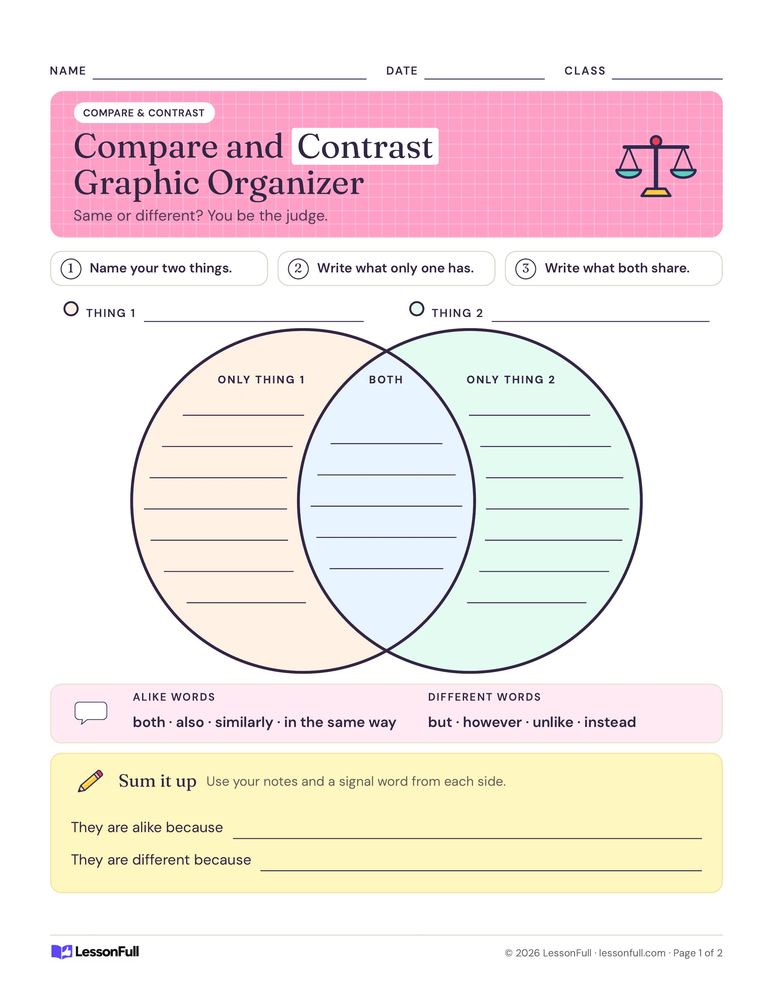
With any story or article, students write three causes, each with an arrow to its effect, then show on a chain strip how one effect sets off the next event. They hunt their text for signal words such as because and so, and decide whether a chosen event is a cause or an effect. Page 2 models the whole organizer with a short text about a windstorm that knocks out power at a school, and a card of three tests for each row starts with reading it as "___, so ___."

Students often put the effect in the cause box when the text names the effect first. In the model text, "teachers rang hand bells" comes before "since the school bells were silent." Read that sentence together and ask which happened first.
Use the model's chain to show that an effect can become the next cause: the school losing power is the effect of the fallen branch and the cause of the cold lunch.
Before students use their own text, cover the model's boxes and have them fill the organizer from the windstorm text, then uncover it and compare.

Ways to adjust the cause-and-effect organizer for different readers.
Each one is checked against the official documents. Where the resource covers only part of a standard, the note says so.
Students find causes and their effects in a text, list signal words such as because, so and as a result, and decide whether an event is a cause or an effect; a filled-in model on the day the power went out shows how. Students bring their own text, so the file has only the one short model passage.
In the chain boxes students show how one event leads to the next and the one after that. The time-and-sequence and technical-steps parts of this standard are not practiced.
Students find causes and effects in a text, record them in boxes and a chain, and note the signal words, as the filled-in power-outage example shows; problem and solution is not covered, and the teacher supplies the text.
Used it in class? Your notes help another teacher plan.