

Students will
Learning objectives
- Write two addition and two subtraction facts for a set of three numbers.
- Find the missing number in a fact family.
- Decide whether three numbers make a fact family.
- Make a fact family from two numbers they choose.

Students write the four addition and subtraction facts for number families up to 20, find missing numbers and decide which sets belong together.
Download the landscape PowerPoint file, open it in Google Slides and save it as Google Slides before assigning a copy to each student. Teacher material stays in the original PDF. Classroom setup instructions.
Last updated
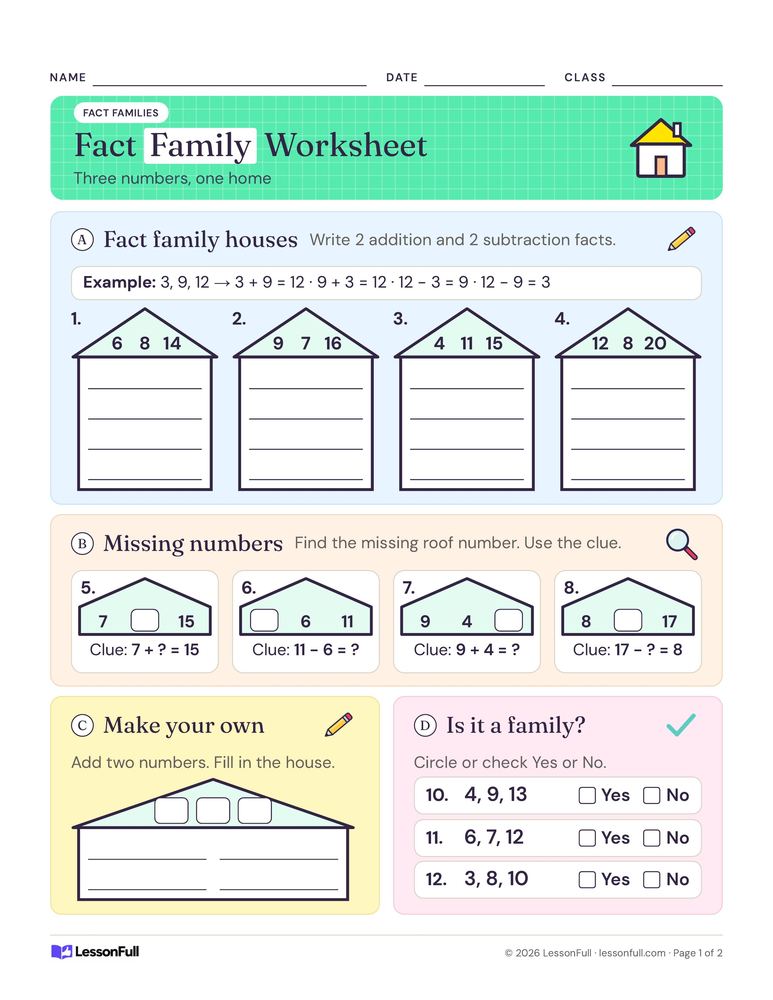
Students write two addition and two subtraction facts for each of four fact family houses. The roof of each house holds the family's three numbers, such as 4, 11 and 15, and a worked example with 3, 9 and 12 sits above them. Four more houses have one roof number missing, each with a clue like 17 − ? = 8, so students can see whether the missing number is a part or the whole before they find it.

Watch for subtraction facts written backward, like 8 − 14. The key's fix: find the biggest number first, since addition facts end with it and subtraction facts start with it.
In Part D, have students add the two smaller numbers before circling: 6 + 7 is 13, so 6, 7 and 12 is not a family.

Ways to adjust the fact family houses for different students.
 Topic 1Counting back
 Topic 2Think additionTopic 3Subtract within 20
 Topic 4Fact familiesYou are here
 Topic 5Word problems
 Topic 6Add or subtract?
Each one is checked against the official documents. Where the resource covers only part of a standard, the note says so.
Students write two addition and two subtraction facts for each set of three numbers up to 20, and make their own fact family.
Students find the missing number in clues such as 7 + ? = 15 and 17 − ? = 8, and decide whether three numbers make a true family.
The fact family houses and clues show that a subtraction fact such as 15 − 7 matches the addition 7 + ? = 15. The file does not ask students to explain this in words.
Students find the missing number in fact families from a clue such as 7 + ? = 15 or 17 - ? = 8, with numbers up to 20.
Students write two addition and two subtraction facts for each family, using the turn-around fact (6 + 8 and 8 + 6), and decide whether three numbers make a family; adding three numbers is not covered.
That worksheet uses fact family triangles with two-digit numbers, plus vertical problems and stories. This page is only fact families, shown as houses, with every whole 20 or less.
Used it in class? Your notes help another teacher plan.


