Students will
Learning objectives
- Trace and write uppercase C and lowercase c in one stroke, starting at the top.
- Tell C and c apart from O, G, Q, e, o and a.
- Say the c sound at the start of cat, cup, car, cow, cake and corn.

Children trace big C and little c from start dots, write them alone, find six Cs among look-alike letters, and trace six c words.
Download the landscape PowerPoint file, open it in Google Slides and save it as Google Slides before assigning a copy to each student. Teacher material stays in the original PDF. Classroom setup instructions.
Materials: none (a tray of sand or salt for the key's game, optional)
Last updated
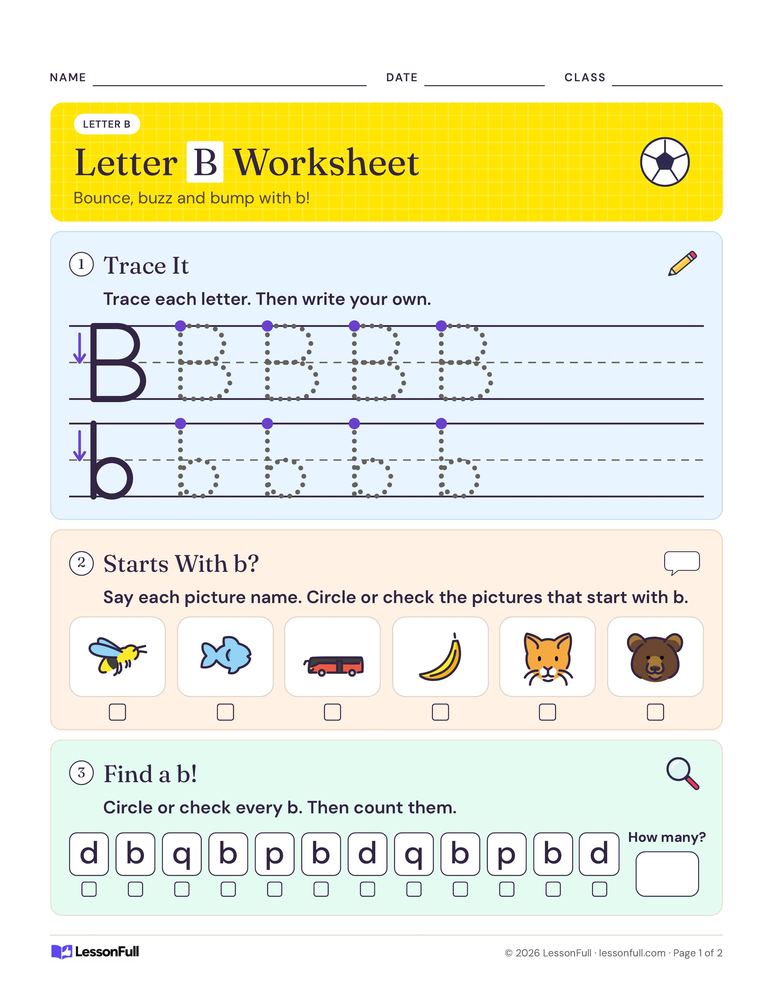
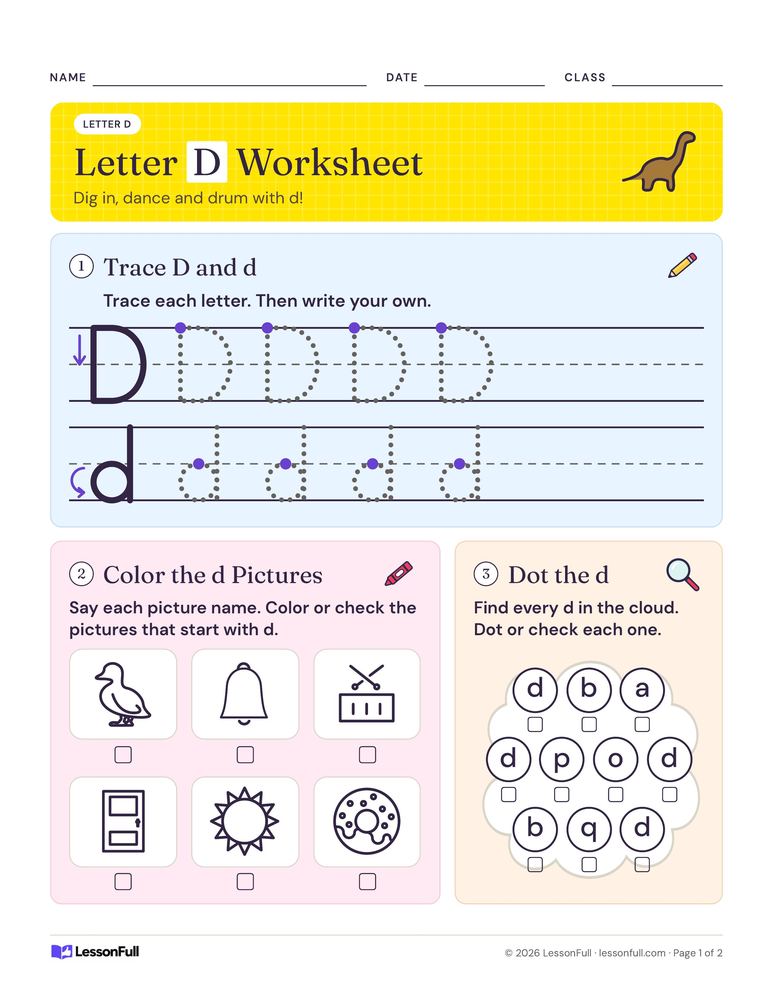
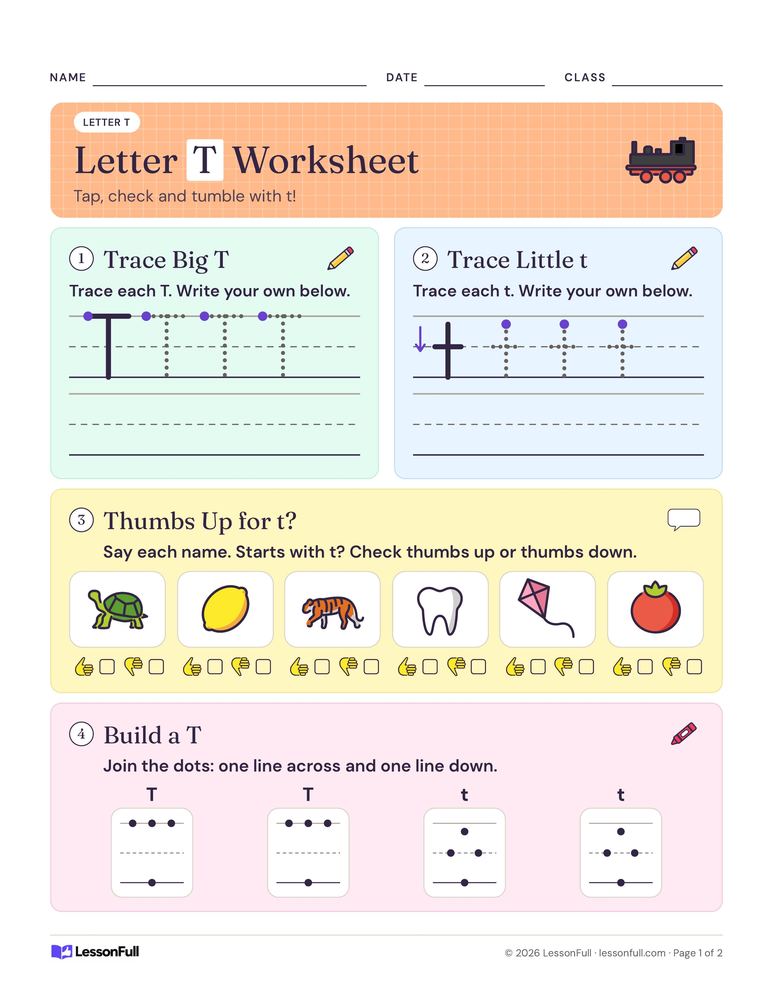
Each letter form gets a road model showing where to start and which way to curve, one row to trace and one row of start dots to write alone: five then six for big C, seven then eight for little c. The direction lines say where to start and stop, so an adult can read them aloud. C or not C mixes 12 bubbles of C and c with O, G, Q, e, o and a. Page 2 ends with six picture words, cat to corn, dotted letter by letter.

Watch the first stroke of little c: it starts just below the dashed middle line, not at the top line. A c that starts at the top line comes out as tall as C.
In C or not C, G and O are the likely slips. Ask whether the letter is open on the right side; C and c never close.
Play Listen for c from the key before page 2: say cap and map, and children curve a C in the air for the c word.

Ways to adjust the C tracing, the letter finder and the word cards.
Each one is checked against the official documents. Where the resource covers only part of a standard, the note says so.
Children trace and then write capital C and small c on their own, starting at a dot near the top and curving around in one stroke. Only one letter is practiced.
Children check every C and c among look-alikes O, G, e, o, Q and a. Only one letter pair is covered.
Children say the names of six pictures that start with c (cat, cup, car, cow, cake, corn) and trace the words; the grown-up guide adds a listen-for-c game. Only the letter c and its hard k sound are covered, and children trace rather than write the letter for the sound.
Students trace and write capital C and small c from a starting dot in one curved stroke; only one letter is practiced.
Students check every C and c among the look-alikes O, G, e, o, Q and a; the other letters are not covered.
Students say the names of pictures that start like cat (cup, car, cow, cake, corn) and trace the words; only the hard c sound is covered.
Yes. Every word, cat, cup, car, cow, cake and corn, starts with the hard c sound as in cat; no soft c words like city appear.
Used it in class? Your notes help another teacher plan.