Compare and Contrast Worksheet

Students mark facts and feelings in a diary entry and an article about hot-air balloons, fill a Venn diagram and name each author's purpose.

Format

Download the landscape PowerPoint file, open it in Google Slides and save it as Google Slides before assigning a copy to each student. Teacher material stays in the original PDF. Classroom setup instructions.

At a glance
Grades
3–5
Pages
3
Type
Worksheet
Includes
Answer key
Answer key included

Last updated

Two texts about hot-air balloons, read with a pencil

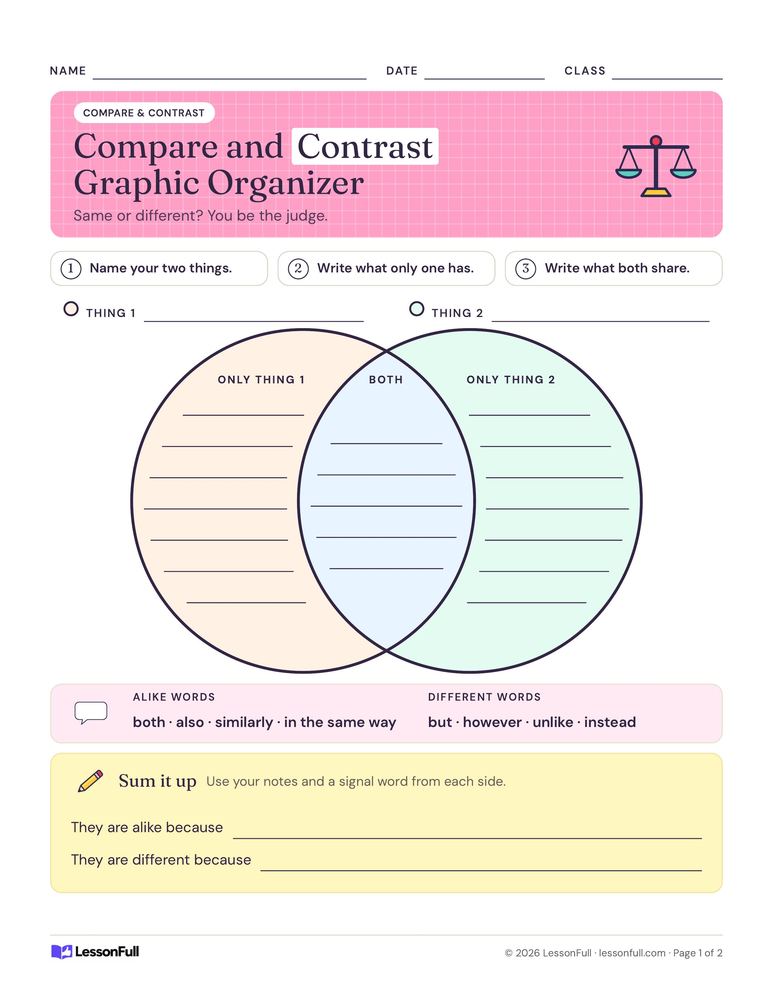
Text A is Mila's diary entry about her first balloon ride; Text B is a 100-word article on how a hot-air balloon flies, with a labeled diagram of the vent, envelope, burner and basket. Before comparing, students underline facts about how a balloon flies and box feeling words, which makes the contrast visible: the facts are almost all in Text B and the feelings only in Text A. Then a three-part Venn diagram asks for two ideas in each part, and students choose each author's purpose from three options.

Bring it into your classroom.

Students will

Learning objectives

  • Tell facts from feeling words in two texts on the same topic.
  • Sort details into what only one text says and what both texts share.
  • Identify each author's purpose and support it with the kind of details the text uses.
  • Write a sentence that states how two texts are alike and how they differ.

From the creator

Teaching tips

1

Students box creaky, roaring and quietly as feeling words. The key accepts them only with an explanation, so ask whether the word tells how Mila felt or how something sounded.

2

For the Both circle, students often write balloons and stop. Push for the shared details the key lists: a burner flame, a basket, a pilot, the balloon drifting.

3

Pair the texts in item 5: the diary cannot have the purpose to explain how something works, since Mila never says why the balloon rises. The key's same-idea-two-ways prompt makes that point with one sentence from each text.

Differentiation

Meet every learner.

Ways to adjust the two texts and the four comparison tasks.

Support

One text at a time

  • Read Text A aloud and box the feeling words together before students read Text B alone.
  • Fill the Text B only part of the Venn first, using the diagram labels as the first idea.
  • Give the three purposes for item 5 as sentence starters: Mila wrote to..., The article was written to...
On level

Teach as written

  • Both pages, with the pencil marks made before the Venn diagram.
  • Students copy one underlined fact for item 4 instead of writing from memory.
Extension

Write the third text

  • Rewrite one paragraph of the article as a diary entry by the pilot, keeping two facts.
  • Add a fourth purpose to the item 5 table, to entertain, and argue which text fits it.
  • Find one sentence in each text that the other text could never say, as in the key's teacher tip.

Standards alignment.

Each one is checked against the official documents. Where the resource covers only part of a standard, the note says so.

Common Core ELA · Grades 3–5
RI.4.6Compare and contrast a firsthand and secondhand account of the same topic

Students read Mila's diary of a balloon ride (firsthand) and an article on how a balloon flies (secondhand), underline facts and box feeling words, sort ideas into a Venn diagram, say which text has more facts and why each author wrote, and finish a sentence telling how the texts are alike and different. Only one pair of texts is used.

RI.3.9Compare and contrast the most important points and key details in two texts on the same topic

The Venn diagram and the summary sentence compare the key details of two texts about hot-air balloons. One text is a personal diary rather than an information text, so this is a partial fit.

RI.5.6Analyze multiple accounts of the same topic, noting similarities and differences in point of view

Students note that Text A is told by I and shows feelings while Text B explains facts, and check why each author wrote. The analysis stays at a checklist and a sentence frame rather than a full written comparison.

TEKS English · Grade 3
3.6(H)Synthesize information across texts

Students read a diary entry and an article about the same hot-air balloon ride, sort ideas into only Text A, both and only Text B, and finish a sentence telling how the two texts are alike and different; only two short texts are compared.

3.10(A)Explain the author's purpose

Students check why each author wrote, to share a personal experience or to explain how something works, and copy a fact from the article; the author's message is not discussed.

Good to know.

Are the texts included?

Yes, both are printed on page 1: Mila's diary entry and the article How a Hot-Air Balloon Flies, each about 100 words, with the balloon diagram beside the article.

No reviews yet.

Used it in class? Your notes help another teacher plan.

Compare and Contrast Worksheet · 3 pages
Compare and Contrast Worksheet — Compare and Contrast Worksheet, Text A: A Diary Entry Mila’s Diary, Text B: An Article How a Hot-Air Balloon Flies (page 1 of 3)
Page 1 of 3 · Page 1
Compare and Contrast Worksheet — Sort your ideas, Compare the texts, Sum it up (page 2 of 3)
Page 2 of 3 · Page 2
Compare and Contrast Worksheet — answer key (page 3 of 3)
Page 3 of 3 · Page 3
ReviewingCompare and Contrast Worksheet

How did it go in your classroom?

Your rating *
How did you use it?