

Addition and Subtraction Within 20 Worksheet: True or False

Students mark six equations with math on both sides true or false, fill six missing numbers, total four dot balances and fix two false equations.

Format

Color, printable and fillable PDFs are ready. Google Classroom is on the way.

At a glance
Grades
1–2
Pages
3
Type
Worksheet
Includes
Answer key

Materials: none (counting cubes optional)

Answer key included

Last updated

Reading the equal sign as the same amount as

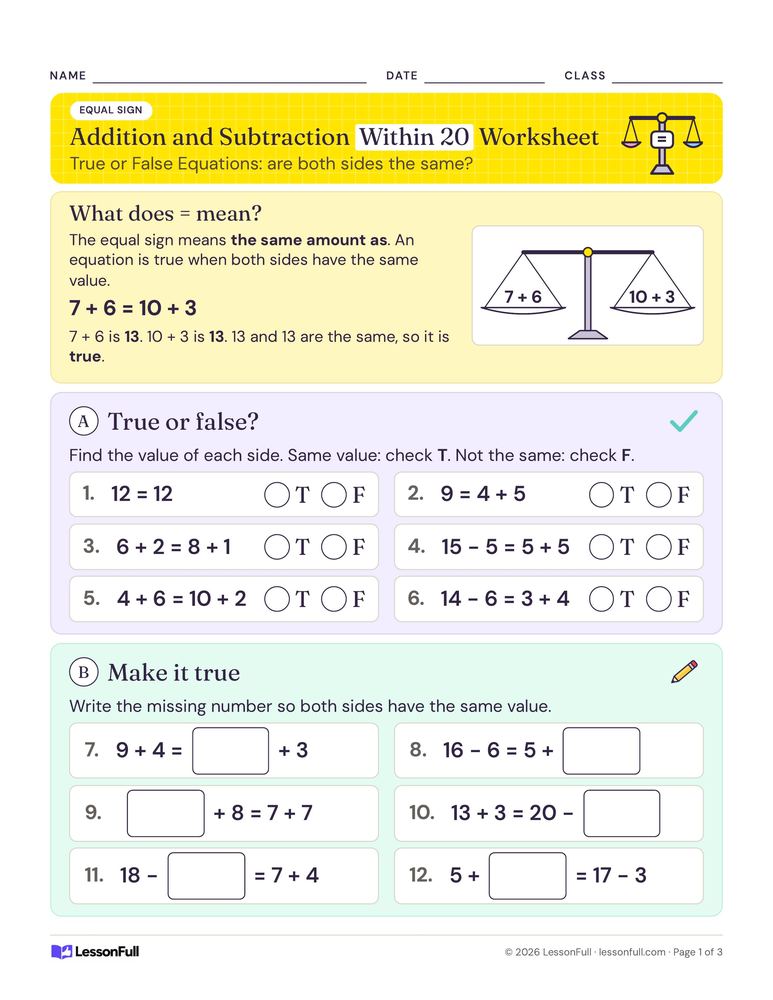
A card at the top shows a level balance and works 7 + 6 = 10 + 3: both sides make 13, so it is true. The six true-or-false items include 9 = 4 + 5, with nothing before the equal sign, and 4 + 6 = 10 + 2, which catches students who read = as the answer comes next. In Make it true the blank moves from side to side. On page 2 students total both pans of four dot balances and say whether each one balances.

Bring it into your classroom.

Students will

Learning objectives

  • Explain that the equal sign means the same amount as.
  • Decide whether an equation with math on both sides is true or false.
  • Write the missing number that makes both sides of an equation equal.
  • Compare the totals of two dot groups to say whether a balance is level.
  • Change one number to turn a false equation into a true one.

From the creator

Teaching tips

1

Item 5, 4 + 6 = 10 + 2, is the trap. A student who marks it true is reading = as the answer comes next; the key suggests building both sides with cubes and comparing the two piles.

2

In item 2, 9 = 4 + 5, the single number is on the left. Students who insist the answer goes on the right may call it false; read it aloud as nine is the same amount as four plus five.

3

Fix it has more than one right answer: 7 + 5 = 13 can become 8 + 5 = 13, 7 + 6 = 13 or 7 + 5 = 12. Ask students to show both sides of their new equation on the Each side line.

Differentiation

Meet every learner.

Ways to adjust the 18 equation and balance items for different students.

Support

Build both sides with cubes

  • Build each side of items 1 to 6 with cubes in two piles before checking T or F.
  • Do the balance scales on page 2 before Make it true; counting dots is easier than finding a missing number.
  • Skip item 6, 14 − 6 = 3 + 4, which needs a subtraction and an addition in the same equation.
On level

Teach as written

  • Both student pages, with the equal-sign card read aloud first.
  • Students write each side's total under items 1 to 6 before marking T or F.
Extension

Write your own

  • Write three true equations with math on both sides, using subtraction on at least one side, for a partner to check.
  • In Fix it, find every one-number change that works for 9 + 3 = 4 + 7; the key lists four.
  • Write a false equation that would fool someone who reads = as the answer comes next.

Standards alignment.

Each one is checked against the official documents. Where the resource covers only part of a standard, the note says so.

Common Core Math · Grade 1
1.OA.D.7Understand the equal sign; decide whether addition and subtraction equations are true or false

Students find the value of each side of equations such as 6 + 2 = 8 + 1 and 15 − 5 = 5 + 5 and mark true or false, count dots on a balance to say whether it will level out, and change one number in a false equation to make it true. All sums and differences stay within 20.

1.OA.D.8Find the unknown number in an addition or subtraction equation

Students write the missing number in equations with an unknown on either side, such as 9 + 4 = ___ + 3 and 18 − ___ = 7 + 4. The unknown is always a single number that makes both sides equal; there are no word problems.

TEKS Math · Grade 1
1.5(E)The equal sign means the same value

Students work out both sides of equations such as 6 + 2 = 8 + 1 and mark them true or false, count the dots on both pans of a balance, and change one number to fix a false equation; every number is 20 or less.

1.5(F)Find the missing number in an equation

Students write the missing number in equations such as 9 + 4 = ? + 3 and 18 − ? = 7 + 4, where the blank can sit on either side; there are no word problems.

Good to know.

Does it have plain addition and subtraction facts to solve?

No. Every item is an equation with two sides to compare: true or false, a missing number, a dot balance or a false equation to repair. Sums and differences stay within 20.

No reviews yet.

Used it in class? Your notes help another teacher plan.

Addition and Subtraction Within 20 Worksheet: True or False · 3 pages · Support 3 · Extension 3
Addition and Subtraction Within 20 Worksheet: True or False — Addition and Subtraction Within 20 Worksheet, What does = mean?, True or false? (page 1 of 3)
Page 1 of 3 · Page 1
Addition and Subtraction Within 20 Worksheet: True or False — Balance check, Fix it (page 2 of 3)
Page 2 of 3 · Page 2
Addition and Subtraction Within 20 Worksheet: True or False — answer key (page 3 of 3)
Page 3 of 3 · Page 3
Addition and Subtraction Within 20 Worksheet: True or False, Support version, page 1
Support version Page 1 of 3
Addition and Subtraction Within 20 Worksheet: True or False, Support version, page 2
Support version Page 2 of 3
Addition and Subtraction Within 20 Worksheet: True or False, Support version, page 3
Support version Page 3 of 3
Addition and Subtraction Within 20 Worksheet: True or False, Extension version, page 1
Extension version Page 1 of 3
Addition and Subtraction Within 20 Worksheet: True or False, Extension version, page 2
Extension version Page 2 of 3
Addition and Subtraction Within 20 Worksheet: True or False, Extension version, page 3
Extension version Page 3 of 3
ReviewingAddition and Subtraction Within 20 Worksheet: True or False

How did it go in your classroom?

Your rating *
How did you use it?