Properties of Water Lab

Students count drops on a coin in three trials, measure water climbing a paper towel strip, and explain both with claim, evidence and reasoning.

Format

Download the landscape PowerPoint file, open it in Google Slides and save it as Google Slides before assigning a copy to each student. Teacher material stays in the original PDF. Classroom setup instructions.

At a glance
Years
5–7
Pages
4
A4
Type
Activity
Includes
Teacher key

Materials: a coin, a dropper, a small cup and a clear glass of water, paper towels and a paper towel strip, a pencil, a metric ruler and a timer; liquid soap for the optional soap test

Last updated

Water drops on a coin and water climbing paper

In Part A, students add water one drop at a time to a dry coin, watch the dome from the side and record the count and the water's shape over three trials. In Part B they hold a paper towel strip in a glass of water for two minutes and measure how far the water climbs. A word bank defines cohesion, adhesion, surface tension and capillary action for the conclusion. Results vary, so the teacher key gives expected patterns and accepts any sensible reason for uneven counts.

Bring it into your classroom.

Students will

Learning objectives

  • Predict, count and record how many drops a coin holds over three trials.
  • Measure how far water climbs a paper strip in two minutes.
  • Describe the dome shape water makes on a coin before it spills.
  • Explain the results using cohesion, adhesion, surface tension and capillary action.
  • Give a reason why repeated trials can give different counts.

From the creator

Teaching tips

1

Step 4 asks for the drops that stayed on before the spill, so the drop that makes it spill isn't counted. Agree on this before Trial 1, or counts won't compare across groups.

2

The key's reasons for uneven counts are drop size, dropper height and a coin that isn't fully dry. Give every group the same kind of coin and dropper so differences come from those, not the equipment.

3

Step 7 measures from the water line, not from the bottom of the strip. The part under the surface is wet anyway and would add to the climb.

Differentiation

Meet every learner.

Ways to adjust the coin and paper strip lab for different students.

Support

Run Part A together

  • Do Part A as a class demonstration, with everyone recording the same three counts.
  • Write the claim together from the word bank, so students write only the evidence and reasoning.
  • Mark a scale on each paper strip ahead of time so students read the climb without a ruler.
On level

Teach as written

  • Both parts, three coin trials and the full conclusion.
  • Groups compare their three counts and use the comparison in Results question 2.
Extension

Change one thing

  • Run the soap test from the teacher key and add it as a fourth row of the data table.
  • Work out the mean of the three counts and compare it with another group's.
  • Repeat Part B with a coffee filter or newspaper strip and compare how far the water climbs.

Curriculum alignment.

Each one is checked against the official document. Where the resource covers only part of a standard, the note says so.

England national curriculum, Science · Years 4–6
Years 5–6Working scientifically

Students count how many drops a penny holds in three trials and record each count, then measure in centimetres how far water climbs a paper towel strip in 2 minutes using a ruler and timer. The ideas the lab teaches (cohesion, adhesion, surface tension) are not part of the key stage 2 content statements.

Years 5–6Working scientifically

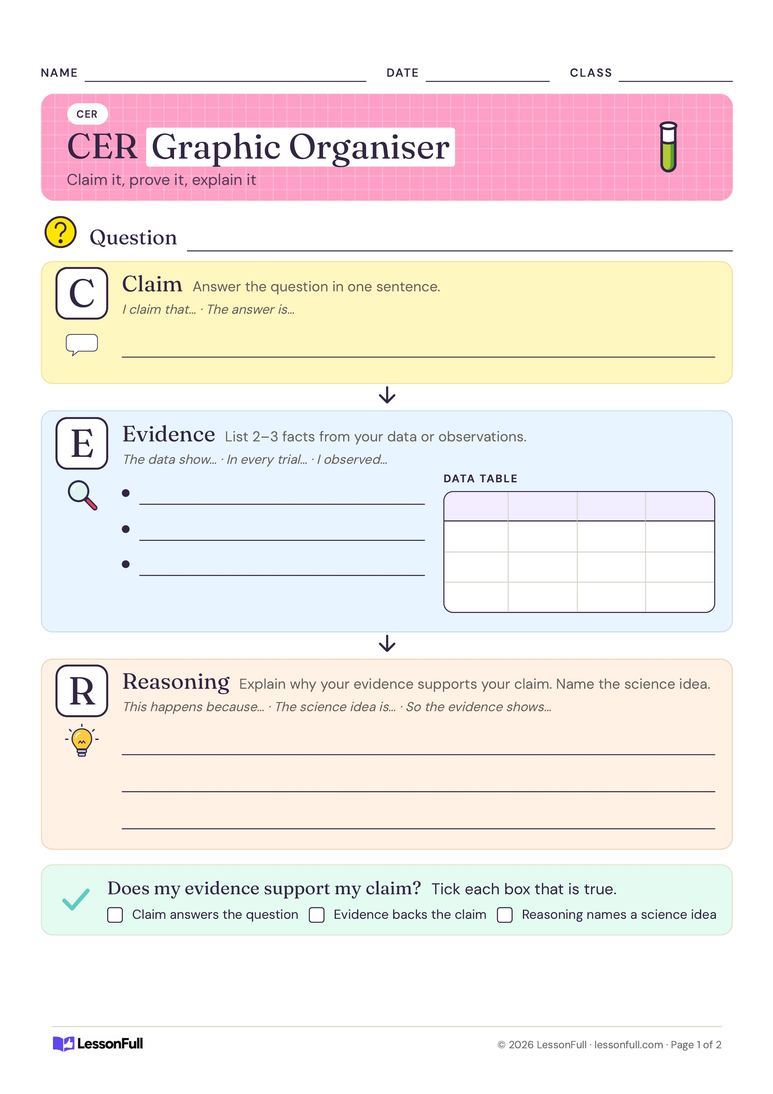
Students write a claim, evidence and reasoning conclusion, explain what pulled the water up the strip, and give a reason why their three counts might differ. Results are written only; oral presentations and displays are not asked.

Years 3–4Working scientifically

Students make a prediction, watch the water's shape on the penny from the side, record it in a table and measure the climb in centimetres. Thermometers and data loggers are not used.

Good to know.

Do I need a particular coin?

Any small coin works if every group uses the same kind, because a larger coin holds more drops. The key gives no exact count, only that it is usually dozens.

No reviews yet.

Used it in class? Your notes help another teacher plan.

Properties of Water Lab · 4 pages
Properties of Water Lab — Properties of Water Lab, Materials, Predict (page 1 of 4)
Page 1 of 4 · Page 1
Properties of Water Lab — Data: Part A, Part B: Paper Towel Strip, Results (page 2 of 4)
Page 2 of 4 · Page 2
Properties of Water Lab — Think About It, Conclusion (page 3 of 4)
Page 3 of 4 · Page 3
Properties of Water Lab — Teacher Key, Expected results, What’s happening (page 4 of 4)
Page 4 of 4 · Page 4
ReviewingProperties of Water Lab

How did it go in your classroom?

Your rating *
How did you use it?