Students will
Learning objectives
- Explain that ten ones make one ten.
- Show and write the numbers 11 to 19 as one ten and some ones.
- Write a teen number as 10 plus a number and find the missing part.
- Decide whether a group is exactly ten ones.

Students circle ten sticks, read cube trains and fill in a chart to show numbers from 10 to 19 as one ten and some ones.
Colour, printable and fillable PDFs are ready. Google Classroom is on the way.
Materials: none (straws and rubber bands optional)
Last updated
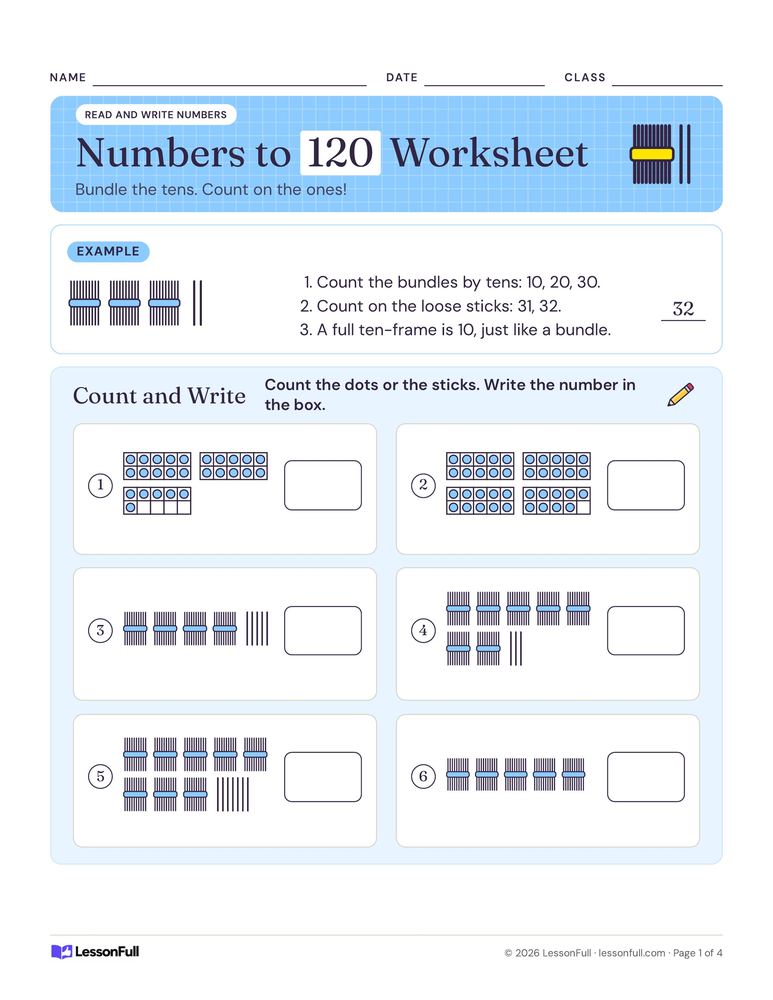
A Make a Ten picture ties 10 loose sticks into 1 ten. Students circle 10 sticks in rows of 13, 16, 11 and 19 and write the tens, ones and number, then read four cube trains. Draw the Ones gives a train of ten beside 15, 11 and 18 for students to finish. Page 3 moves to numbers only: 10 + 6, 19 = 10 + □ and 1 ten 0 ones, a chart for 17, 12 and 10, and four scattered cube groups to judge as exactly ten or not.

Item 16, 1 ten 0 ones, is the one students leave blank or answer with 1. Point to row 20 of the chart, where 10 is written as 1 ten and 0 ones.
Item 22 has 9 cubes and item 23 has 12. Have students touch and count each cube aloud; students who judge by the spread often mark both as one ten.

Ways to adjust the stick, cube-train and number-only tasks.
Each one is checked against the official document. Where the resource covers only part of a standard, the note says so.
Students bundle ten sticks, break teen numbers into 1 ten and some ones (10 + 6 = 16, 19 = 10 + ?), fill in a tens and ones chart and decide whether a group is exactly ten. Only numbers from 10 to 19 are used, each split one way.
Students read teen numbers from stick and cube-train pictures and draw the ones for 15, 11 and 18. Everyday uses of numbers are not discussed.
No. Every number is from 10 to 19. Two-digit numbers beyond 19 come in the next step.
Used it in class? Your notes help another teacher plan.